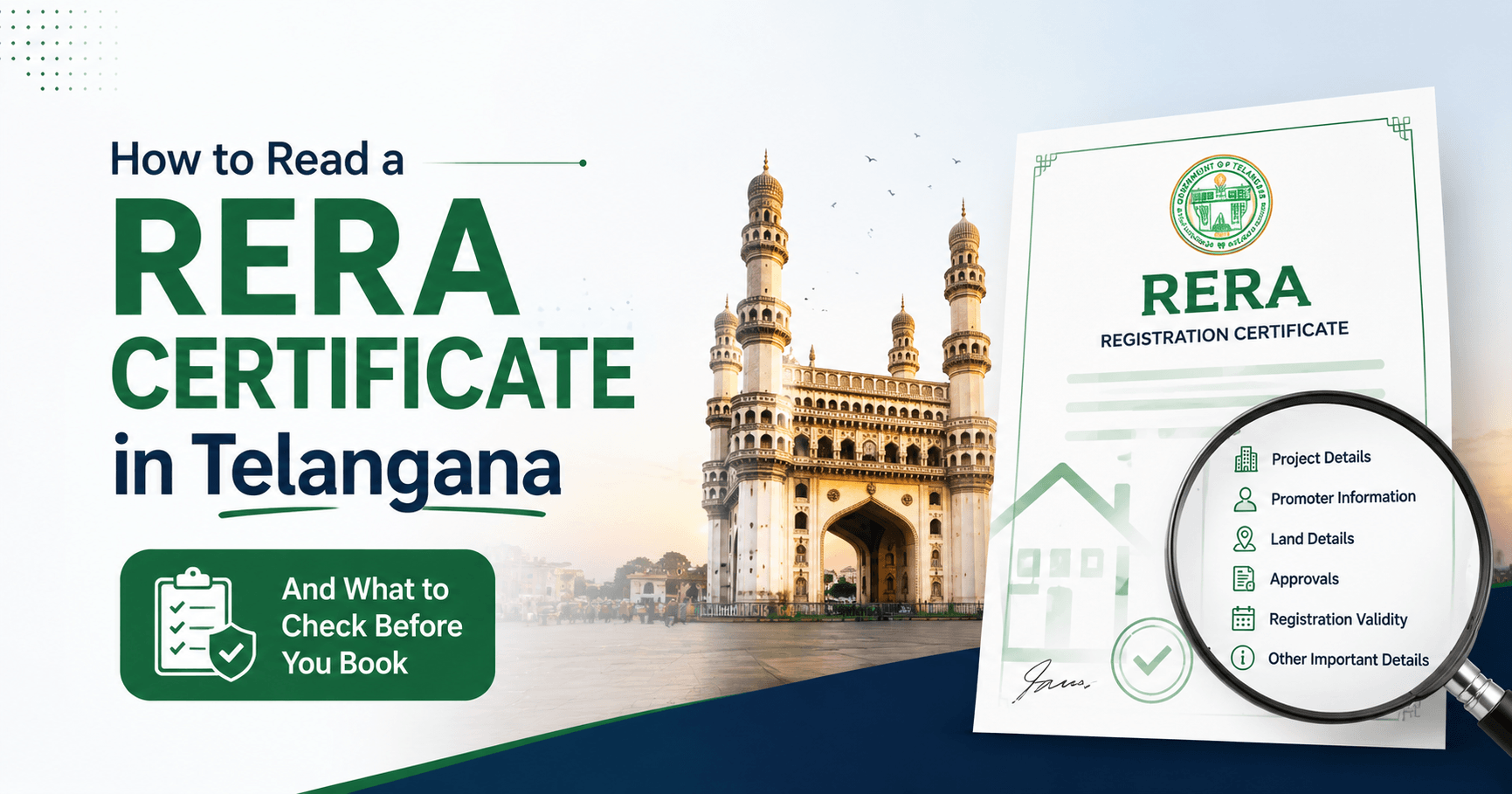
How to Read a RERA Certificate in Telangana — And What to Check Before You Book

Written by Vuddar Madhava Rao
Vuddar Madhava Rao is the Founder and Managing Director of VMR Buildcon, a Hyderabad-based real estate developer and turnkey construction company. Since founding VMR Buildcon in January 2000, he has led the delivery of premium residential and commercial projects across Hyderabad, Bangalore, Mumbai, and Vapi — first as a turnkey contractor for established real estate developers, and since 2018 as the developer of VMR Buildcon's own residential community projects.
With over 26 years in construction and real estate, Madhava Rao has built a reputation for engineering precision, on-time delivery, and uncompromising quality standards. Projects delivered under his leadership include Mulberry Meadows, Sai Nest, Sarthak, Fortune Meadows, Westend Meadows, Ipsit Anand Mangal (Borivali West, Mumbai), 21 Square (Borivali West, Mumbai), Satyam II (Malad East, Mumbai), Marquis (Malad West, Mumbai), and Golden Gateway (Borivali East, Mumbai), among others.
VMR Buildcon's current flagship own-development upcoming project is Near Kompally — a 6.75-acre gated community in Gowdavalli, North Hyderabad, that synthesises two and a half decades of construction lessons into a single premium residential development. The project is curated in collaboration with renowned architect Niroop Kumar Reddy.
Beyond VMR Buildcon, Madhava Rao founded Subcontracts.in in 2017 — a civil and infrastructure works contracting and PMC consulting business serving the industrial, warehousing, textiles, IT, tourism, hospitality, and renewable energy sectors across India. He is also the Managing Director of Motoron Automotive Lubricants Pvt Ltd.
Beyond execution, Madhava Rao is an active voice in Hyderabad's real estate market commentary, regularly publishing analysis on Medium and LinkedIn covering North Hyderabad's infrastructure-led growth, the impact of the Kandlakoya IT Park on residential pricing, and the emergence of the Gowdavalli–Kompally corridor as Hyderabad's next premium residential destination.
"Building dreams. Delivering trust. Over two and a half decades at the foundation of Hyderabad real estate."
Education
• Bachelor of Science (BS), Computer Science — Osmania University, Hyderabad (1993–1996)
• Government Model Basic High School, Mahabubnagar, Andhra Pradesh
Languages
English · Hindi · Telugu · Kannada
Areas of Expertise
• Residential real estate development
• Turnkey construction and project management
• Gated community planning and execution
• Hyderabad real estate market analysis
• Construction quality systems and engineering precision
• Civil and infrastructure works contracting (PMC consulting)
• Multi-city project delivery — Hyderabad, Bangalore, Mumbai, Vapi
Other Leadership Roles
• Founder & Principal Consultant, Subcontracts.in (August 2017 – present) — Civil & infrastructure works contracting and PMC consulting
• Managing Director, Motoron Automotive Lubricants Pvt Ltd (June 2017 – present)
Connect
• LinkedIn: https://in.linkedin.com/in/vmadhavarao (32,000+ followers)
• VMR Buildcon: https://vmr.in
• Medium: https://vmrbuildcon.medium.com
• Subcontracts.in: https://www.subcontracts.in
In His Own Words
"Every home we deliver carries the trust of families who place their future in our hands. At VMR, our commitment is to quality, transparency and lasting value."
— Vuddar Madhava Rao
Most home buyers in Hyderabad make a big mistake right at the beginning. They walk into a sales office, listen to a very confident presentation, see beautiful renderings of the project, and ask just one question: 'What is the price?'
The question they should have asked first is: 'Can I see your RERA certificate?'
A RERA certificate is not a formality. It is a legal document that tells you whether a project is approved, what exactly is being built, when it must be completed, and what your rights are if something goes wrong. Once you know how to read it, a one-page government certificate gives you more real information than a hundred pages of a developer's brochure.
This guide walks you through exactly what a RERA certificate contains, how to find and read one for any project in Telangana, what five things to check before paying a rupee, and what the red flags look like — in plain language, no legal background needed.
📋 What You Will Learn By the end of this guide, you will know what RERA is and why it matters in Telangana, how to pull up and read a RERA certificate in under 5 minutes, the 5 critical things to verify before booking, the 7 red flags that should stop you from paying any advance, and what your legal rights are if a builder delays or defaults. |
What Is RERA and Why Does It Exist?
RERA stands for the Real Estate (Regulation and Development) Act, 2016. It came into force across India on 1st May 2017. In Telangana, it is implemented by the Telangana Real Estate Regulatory Authority, commonly known as TG RERA or TS RERA.
Before RERA, buying a home under construction in India was a gamble. Builders collected money from buyers, made grand promises about delivery timelines, and then used that money for other projects or personal expenses. Projects got delayed by 5-10 years. Thousands of families paid EMIs on loans for flats they couldn't live in. Buyers had almost no legal recourse — courts were slow and the cases could drag on for decades.
RERA changed this by establishing three simple rules that every builder must follow:
Register the project before selling even one flat — no advertisements, no token advances, nothing without registration
Put 70% of every rupee collected from buyers into a separate escrow account, which can only be used for that specific project's construction and land costs
Update construction progress publicly on the RERA portal every 3 months — buyers can see exactly what stage the project is at
The result is that today, a RERA-registered project in Telangana is one where the government knows what's being built, where it's being built, when it should be complete, and how much money the builder has collected. That's a fundamentally different level of accountability than what existed before 2017.
Before vs After | What Changed |
Before RERA | Builders collected money with no escrow, built at their own pace, and buyers had almost no legal protection if things went wrong |
After RERA | 70% of funds go to escrow, quarterly progress reports are public, buyers have enforceable rights and a fast complaint mechanism |
Registration Requirement | No project exceeding 500 sq m or 8 units can advertise or sell without a valid RERA registration number |
Penalty for Non-compliance | Up to 10% of project cost as penalty; imprisonment up to 3 years for continued violations |
Which Projects Must Be RERA Registered in Telangana?
Not every construction project in Telangana needs RERA registration. Here's what applies and what doesn't:
Projects That MUST Register with TG RERA:
Any residential or commercial project where the plot area is 500 square metres or more
Any project with 8 or more dwelling units across all phases
Any ongoing (under-construction) project that did not have a completion certificate as of 4th August 2017, when Telangana's RERA rules came into force
Each phase of a phased development is treated as a separate project and must register separately
Projects Exempt from RERA:
Projects on plots smaller than 500 sq m AND with fewer than 8 units — both conditions must apply for exemption
Projects that received their completion certificate before 4th August 2017
Pure renovation or repair work where no new units are being sold
The Exemption Trick — Watch For This Some developers try to split large projects into smaller sub-components just to fall below the 500 sq m/8-unit threshold. Under TG RERA rules, all phases of a development on connected land are treated as one project for registration purposes. If a builder tells you their project is 'exempt from RERA' on a site that's clearly a multi-building complex, that's a red flag. Check on the TG RERA portal before taking their word for it. |
What's Inside a RERA Certificate? Reading It Field by Field
The RERA Registration Certificate in Telangana is officially called Form 'C' (See Rule 5(1)). It is issued by the TG RERA Authority after verifying the developer's application. Here is what each part of the certificate tells you — and why it matters:
STEP 01 | Project Registration Number |
This is the unique ID assigned to the project by TG RERA. In Telangana, project RERA numbers follow a format like P02200XXXXXX or P02400XXXXXX — the 'P' stands for Project (as opposed to 'A' for Agent).
Why it matters: This is the number you will type into the TG RERA portal to pull up everything the developer has filed. Every advertisement, brochure, or hoarding for a registered project must display this number in the top right corner, in font size equal to or larger than the project's contact details. If an ad doesn't show a RERA number, the project cannot legally be sold.
☐ Note down the RERA number from the brochure or sales office
☐ Search it on rera.telangana.gov.in to confirm it matches this exact project and promoter
☐ Confirm the number format starts with P followed by digits — not a fake or incomplete number
STEP 02 | Project Name and Location |
The certificate states the official project name, survey numbers of the land, plot numbers, locality, mandal, and district — exactly as filed by the developer.
Why it matters: Cross-check the project location on the certificate against what the developer shows you on a map. Survey numbers and plot numbers are public records you can verify with the Sub-Registrar's office or on Dharani (Telangana's land records portal). If the certificate shows Survey No. 501, 509 but the developer's brochure says the project is at a different survey number, that's a discrepancy that needs explanation.
☐ Match the survey number and plot number in the certificate against what the developer says
☐ Check the address on the certificate against the physical site location
STEP 03 | Promoter Details |
The certificate names the legal promoter — the entity or individual who is legally responsible for the project. This may be a company, a partnership firm, or an individual. It includes the promoter's address and is digitally signed by the TG RERA Authorised Officer.
Why it matters: This is the person or entity you have a legal contract with. Many buyers don't check this. The sales agent who calls you, the developer brand on the hoarding, and the company name in the brochure can all be different from the legal promoter. Always check who the promoter is — because if the project delays and you need to file a complaint, the complaint goes against the registered promoter, not the brand name.
💡 Joint Development Projects — Special Attention On some projects, you may find that the land owner and the builder are different entities. In a joint development arrangement, both parties may be listed as promoters. Separately, you may find that the actual construction is carried out by a third-party turnkey contractor. In such cases, the RERA certificate will name the legal promoter, not the contractor. When booking your flat, always confirm who you're signing the agreement with, and make sure it's the RERA-registered promoter. |
☐ Confirm the promoter name on the certificate matches the name in the sale agreement you'll be signing
☐ Look up the promoter's other projects on the TG RERA portal — check their track record on past deliveries
STEP 04 | Registration Validity Period |
The certificate shows the exact start and end date of the registration — for example, '12/05/2026 to 12/05/2029'. This is the window within which the developer must complete the project and obtain the Occupancy Certificate.
Why it matters: This date is the developer's legal possession commitment. If the project is not completed by this date, the developer is in breach of RERA and you have the legal right to either claim compensation (monthly interest for every month of delay at SBI's Marginal Cost of Lending Rate + 2%) or exit the project and claim a full refund with interest.
If a project's RERA validity date has already passed and you can see on the portal that no extension has been filed, the developer is operating without valid RERA coverage — which means your money has no RERA protection.
☐ Check that the registration end date is in the future
☐ Compare the possession date the developer promises you in the sales conversation with the RERA validity date — if the developer verbally promises a date earlier than RERA validity, ask why the two differ
☐ Check if there is any extension already filed (the portal will show this under the project's history)
STEP 05 | RERA Conditions |
The certificate contains standard conditions that the promoter must comply with. These include entering into a registered agreement for sale with every allottee, depositing 70% of collected funds into a separate escrow account, submitting quarterly progress updates, and not contravening any law applicable to the project.
Why it matters: These conditions are enforceable legal obligations. If the developer breaches any of them — for example, by not putting funds into escrow or by failing to file quarterly updates — TG RERA can impose penalties or even suspend the registration.
☐ Look at the project's quarterly progress reports on the portal to confirm the developer is actually filing them — a developer who has stopped filing updates may be in financial trouble
How to Pull Up Any RERA Certificate in Under 5 Minutes
You don't need an agent, a lawyer, or any paid service to verify a project's RERA status. Here is the exact step-by-step:
Open a browser and go to: rera.telangana.gov.in
On the homepage, look for 'Search Projects' or 'Registered Projects' in the top menu
You can search by: Project Name, Promoter Name, or RERA Registration Number
Click on the project from the results to open its full profile
The profile page will show: the Registration Certificate (downloadable as PDF), all uploaded documents including the sanctioned plan, the latest quarterly progress report, and any registered complaints against the project
Download the Registration Certificate and save it to your phone or computer
TG RERA Contact Details (If You Need to Call) TG RERA Office: DTCP Building, Ground Floor, 640, A.C. Guards, Masab Tank, Opp. PTI Building, Hyderabad - 500004. Phone: 040-29394973 / 040-29394974 WhatsApp: 9000006301 Email: rera-maud@telangana.gov.in Office Hours: Monday to Saturday, 10:30 AM - 5:00 PM |
5 Things to Verify Before Paying Any Advance
Pulling up the certificate is step one. Here are the five things to actually look at once you have it:
1. Is the Registration Active or Expired?
An expired RERA registration means the developer's legal timeline has run out. They may have applied for an extension (which must be approved by TG RERA), or they may have simply crossed their deadline. Either way, if the registration shows as expired without an extension, the project has no current RERA cover, and your booking advance has no RERA protection. Check the validity end date. Confirm it is in the future.
2. Do the Quarterly Progress Reports Match What You Can See?
On the project's portal page, you will find Quarterly Progress Reports (QPRs) filed by the developer. These reports state what percentage of construction is complete, how much money has been collected from buyers, and the status of the escrow account. This is the single most powerful tool you have to cross-check a developer's claims.
If a developer's sales team tells you 'construction is 60% complete ', but the latest QPR on the portal says 20%, or if the last QPR was filed over 6 months ago — that's a major red flag. Developers who stop filing QPRs are often in financial or construction trouble.
How to Read a QPR Open the project on the TG RERA portal and look for 'Quarterly Progress Reports' or 'Project Updates'. The most recent QPR will show: (1) current construction stage (foundation/structure/finishing), (2) percentage of total construction completed, (3) number of units booked so far, and (4) escrow account balance. Compare this with what the developer is telling you verbally. If numbers diverge significantly, ask for a written explanation before paying anything. |
3. Does the Sanctioned Plan Match What's Being Sold to You?
The developer must upload the HMDA/GHMC/MMC-approved sanctioned building plan to the TG RERA portal. This plan is the legal blueprint of the project — the exact number of floors, units, common areas, parking, and amenities that are officially approved.
Download the sanctioned plan and compare it to the brochure. Check: does the brochure promise 8 floors when only 6 are sanctioned? Does the developer's layout show a clubhouse where the plan shows a parking area? The sanctioned plan is the legally binding version — what's in the brochure is marketing. Whatever is not in the sanctioned plan cannot be demanded as a legal right.
4. Are There Any Registered Complaints Against the Developer?
The TG RERA portal shows all complaints filed against a promoter, across all their projects — not just the one you're evaluating. Search the promoter's name and check their full complaint history. A few resolved complaints are not unusual for a large developer. What's concerning is a pattern of the same type of complaint (e.g., multiple delay complaints on multiple projects) or complaints that remain unresolved for a long time.
5. Check the Developer's Track Record on Past Projects
On the portal, each registered promoter has a profile that lists all their projects — past and present. Look at their completed projects. Did they deliver on time? Were there complaints? Did any projects require extension? A developer who has consistently delivered clean, on-time projects is far less risky than a developer who has a history of delays even on smaller projects. This is public information. Use it.
7 Red Flags That Should Stop You From Paying
Beyond the five checks above, here are the warning signs that should make you pause — or walk away entirely:
Red Flag 1: No RERA Number on Brochures or Hoardings Every advertisement, brochure, social media post, and hoarding for a RERA-registered project must display the RERA registration number. If you're handed a brochure with no RERA number — or a number that doesn't appear on the TG RERA portal — the project cannot legally be selling to you. Do not pay any advance until you have a verified RERA number in your hand. |
Red Flag 2: 'Pre-Launch' Offers Before RERA Is Registered You will often hear developers say 'book now at pre-launch prices before RERA registration comes through.' This is illegal. No developer in Telangana can accept a booking amount or sign any agreement for sale before obtaining RERA registration. If you pay at this stage, your money has zero legal protection — if RERA rejects the application or the developer walks away, you have no enforceable claim. |
Red Flag 3: QPRs Not Filed for More Than 3 Months Developers must file quarterly progress reports every three months under TG RERA rules. If the last report on the portal is more than 3-4 months old, the developer is already in violation of RERA's compliance requirements. This is often an early signal of financial trouble or construction stoppages. Don't take the developer's verbal update as a substitute — check the portal yourself. |
Red Flag 4: Brochure Units Don't Match Portal Units The RERA portal shows exactly how many units have been sanctioned for the project. If the developer is advertising 120 flats but the RERA portal only shows approval for 90, those extra 30 units are unauthorized. Buying an unauthorized unit means you cannot get home loans from most banks, cannot register the property legally, and have no RERA protection. |
Red Flag 5: Possession Date Only Verbal, Not in Agreement If a developer promises possession 'by December 2027' but the sale agreement doesn't mention this date, or lists a later date, the verbal promise is worthless in court. The possession date that matters is the one in your signed, registered sale agreement — which must match the RERA certificate's validity date. Never pay an advance based on a verbal timeline. |
Red Flag 6: Developer Hesitates to Show the RERA Certificate Any reputable, registered developer will hand you the RERA certificate without being asked. If a developer's sales team deflects, says 'the certificate is being processed,' offers to show you 'later,' or gives you a RERA number that doesn't match the portal — stop. A registered project's RERA certificate is a public document. There is no legitimate reason for any delay in sharing it. |
Red Flag 7: Phased Project, But Only Phase 1 Is Registered Large township-style developments are sometimes registered phase by phase. If you're buying in Phase 3 of a project but only Phase 1 has a valid RERA registration, your phase has no RERA protection. The developer may tell you 'Phase 3's RERA is coming soon' — until it does, any money you pay for a Phase 3 unit is at risk. Each phase must have its own registration before any sales begin. |
Your Legal Rights Under RERA If Things Go Wrong
Even after all the due diligence, projects can delay. Here's what RERA gives you if that happens:
Situation | Your RERA Right |
If the builder delays possession | You can claim monthly interest at SBI MCLR + 2% for every month of delay — or claim a full refund with interest if you choose to exit |
If the builder changes the approved plan | Any change to the sanctioned plan requires your written consent. You can refuse and demand the original specifications be delivered |
If the project is abandoned | File a complaint with TG RERA. The authority can order the promoter to complete the project, pay refunds, or even take over the project for completion |
How to file a complaint | Visit rera.telangana.gov.in → Complaints → File a complaint online. Provide the RERA number, your allotment letter, payment receipts, and agreement. TG RERA is required to hear and decide complaints within a fixed timeframe |
Complaint fee | A nominal fee is payable at the time of filing; the amount varies based on the value of the complaint |
Penalty on the builder | TG RERA can impose up to 10% of the project cost as penalty; continued non-compliance can lead to imprisonment up to 3 years |
Your RERA Verification Checklist — Print and Use
Before paying any advance or signing any agreement for a project in Hyderabad or anywhere in Telangana, tick off every item on this list:
Step 1 — Find the RERA Certificate
☐ Get the RERA registration number from the brochure or sales team
☐ Search it on rera.telangana.gov.in and confirm the project is listed
☐ Download and save the Registration Certificate (Form C) as PDF
Step 2 — Read the Certificate
☐ Confirm the project name and location match what you are being shown
☐ Note the promoter's legal name — this is who you're contracting with
☐ Check the registration validity end date — is it in the future?
☐ Confirm the number of units sanctioned matches what the developer is selling
Step 3 — Check the Quarterly Progress Reports
☐ Open the project's QPR section on the portal
☐ Confirm a QPR has been filed within the last 3 months
☐ Check construction completion % — does it match what you're being told on-site?
☐ Check the escrow account status — is 70% of collected funds protected?
Step 4 — Check the Developer's Track Record
☐ Search the promoter's name on the portal and look at all their projects
☐ Check past projects for delays, complaints, or unresolved issues
☐ Confirm no outstanding complaints from previous buyers remain unresolved
Step 5 — Cross-Check the Sale Agreement
☐ Confirm the possession date in the agreement matches the RERA validity date
☐ Confirm the carpet area (not super built-up area) is stated clearly in the agreement
☐ Confirm all verbal promises about amenities are listed in the agreement
☐ Have a property lawyer review the agreement before signing
Evaluating a VMR Buildcon Project? VMR Buildcon's construction projects follow the same RERA compliance standards described in this guide. SAI NEST, Malkajgiri (RERA Reg. No. P02200010954) is one such example — a new launch with a publicly verifiable RERA certificate on the TG RERA portal. For VMR Buildcon's upcoming residential project in Gowdavalli near Kompally, full RERA registration will be shared the moment approvals are received — before any bookings are accepted. Call or WhatsApp: +91 922 330-9999 | Visit: vmr.in | Email: info@vmrbuildcon.com |
Disclaimer: This article is intended as a general informational guide for property buyers in Telangana. It is not legal advice. RERA regulations, portal features, and complaint procedures are subject to change. Always verify current information on the official TG RERA portal at rera.telangana.gov.in. Readers are advised to consult a qualified property lawyer before completing any property transaction. VMR Buildcon does not provide legal advice.
Frequently asked questions
Yes, for projects where the plot area is 500 square metres or more, or where there are 8 or more dwelling units in total. Projects below both thresholds are exempt. All under-construction projects that did not have a completion certificate when TG RERA rules came into force on 4th August 2017 also had to register retrospectively.
Go to rera.telangana.gov.in, click on 'Search Projects' or 'Registered Projects', and enter the project name, promoter name, or RERA number. The portal shows the project's registration status, certificate, sanctioned plan, quarterly progress reports, and any registered complaints — all publicly accessible without logging in.
Project registration numbers in Telangana follow the format P022XXXXXXXX or P024XXXXXXXX — starting with the letter 'P' (for Project). Agent registration numbers start with 'A'. If a developer shows you a number that doesn't match this format, or a number that doesn't appear on the portal, do not proceed.
No. Under the RERA Act, no developer can advertise, market, or accept any booking amount or advance for any unit before obtaining RERA registration. Any money paid before registration is not protected by RERA. If you paid before registration and the project runs into trouble, your legal options are significantly weaker.
Under RERA, you have two options: (1) Stay in the project and claim monthly interest compensation at SBI MCLR + 2% for every month of delay, or (2) Exit the project and claim a full refund of all amounts paid, along with interest. File your claim as a complaint on the TG RERA portal with your allotment letter, payment receipts, and the agreement.
Yes. The TG RERA portal covers all projects within Telangana state, including projects in GHMC, HMDA, Malkajgiri Municipal Corporation, DTCP, and all other municipal authority areas. You can filter projects by district on the portal search page.
These are two different types of regulatory approvals. The RERA number is issued by the Telangana Real Estate Regulatory Authority and governs sales, disclosures, and buyer rights. The building permit number is issued by the local municipal authority (GHMC, HMDA, MMC, etc.) and governs construction permissions — confirming the structure, height, setbacks, and number of floors are legally approved. A valid project should have both: a current RERA registration AND a valid building permit from the relevant municipal body.