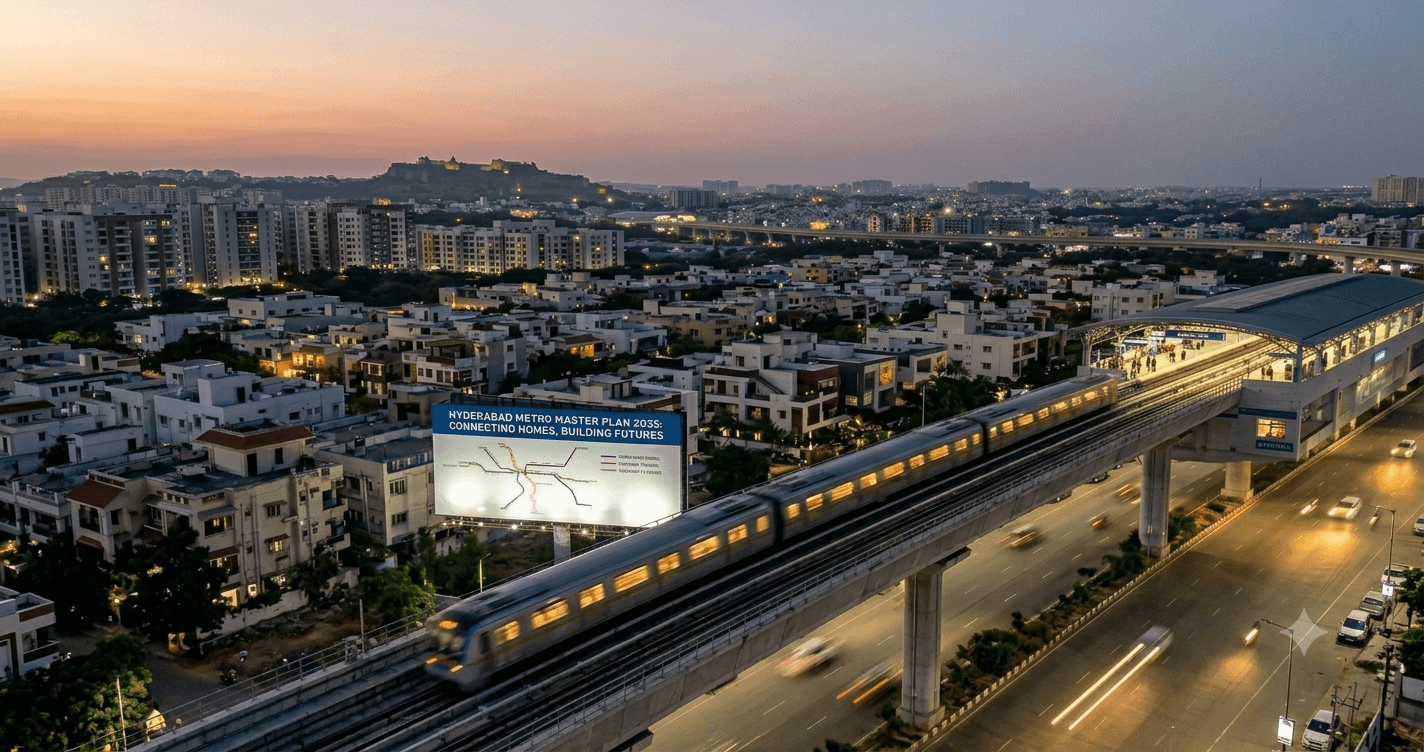
Hyderabad's Metro Master Plan 2035: What 391 KM of Rail Means for Your Home Investment
The Telangana government has unveiled one of India's most ambitious metro expansion visions — a network stretching nearly 391 km that could rewrite the real estate map of Hyderabad. VMR Buildcon decodes what it means, where the opportunity lies, and how to invest wisely.

Written by Vuddar Madhava Rao
Vuddar Madhava Rao is the Founder and Managing Director of VMR Buildcon, a Hyderabad-based real estate developer and turnkey construction company. Since founding VMR Buildcon in January 2000, he has led the delivery of premium residential and commercial projects across Hyderabad, Bangalore, Mumbai, and Vapi — first as a turnkey contractor for established real estate developers, and since 2018 as the developer of VMR Buildcon's own residential community projects.
With over 26 years in construction and real estate, Madhava Rao has built a reputation for engineering precision, on-time delivery, and uncompromising quality standards. Projects delivered under his leadership include Mulberry Meadows, Sai Nest, Sarthak, Fortune Meadows, Westend Meadows, Ipsit Anand Mangal (Borivali West, Mumbai), 21 Square (Borivali West, Mumbai), Satyam II (Malad East, Mumbai), Marquis (Malad West, Mumbai), and Golden Gateway (Borivali East, Mumbai), among others.
VMR Buildcon's current flagship own-development upcoming project is Near Kompally — a 6.75-acre gated community in Gowdavalli, North Hyderabad, that synthesises two and a half decades of construction lessons into a single premium residential development. The project is curated in collaboration with renowned architect Niroop Kumar Reddy.
Beyond VMR Buildcon, Madhava Rao founded Subcontracts.in in 2017 — a civil and infrastructure works contracting and PMC consulting business serving the industrial, warehousing, textiles, IT, tourism, hospitality, and renewable energy sectors across India. He is also the Managing Director of Motoron Automotive Lubricants Pvt Ltd.
Beyond execution, Madhava Rao is an active voice in Hyderabad's real estate market commentary, regularly publishing analysis on Medium and LinkedIn covering North Hyderabad's infrastructure-led growth, the impact of the Kandlakoya IT Park on residential pricing, and the emergence of the Gowdavalli–Kompally corridor as Hyderabad's next premium residential destination.
"Building dreams. Delivering trust. Over two and a half decades at the foundation of Hyderabad real estate."
Education
• Bachelor of Science (BS), Computer Science — Osmania University, Hyderabad (1993–1996)
• Government Model Basic High School, Mahabubnagar, Andhra Pradesh
Languages
English · Hindi · Telugu · Kannada
Areas of Expertise
• Residential real estate development
• Turnkey construction and project management
• Gated community planning and execution
• Hyderabad real estate market analysis
• Construction quality systems and engineering precision
• Civil and infrastructure works contracting (PMC consulting)
• Multi-city project delivery — Hyderabad, Bangalore, Mumbai, Vapi
Other Leadership Roles
• Founder & Principal Consultant, Subcontracts.in (August 2017 – present) — Civil & infrastructure works contracting and PMC consulting
• Managing Director, Motoron Automotive Lubricants Pvt Ltd (June 2017 – present)
Connect
• LinkedIn: https://in.linkedin.com/in/vmadhavarao (32,000+ followers)
• VMR Buildcon: https://vmr.in
• Medium: https://vmrbuildcon.medium.com
• Subcontracts.in: https://www.subcontracts.in
In His Own Words
"Every home we deliver carries the trust of families who place their future in our hands. At VMR, our commitment is to quality, transparency and lasting value."
— Vuddar Madhava Rao
Hyderabad has always grown along its infrastructure spine. The first metro phase transformed Miyapur, Gachibowli, Uppal, and Kukatpally from peripheral suburbs into prime residential zones. Now, the Telangana government is proposing something far more audacious: a metro network spanning 391–415 km that could make Hyderabad home to one of the largest urban rail systems in the country.[1]
At the centre of this vision is a proposed 160 km Outer Ring Road (ORR) Metro Ring Corridor — a circular orbital metro connecting Hyderabad's fastest-growing peripheral zones: Kokapet, Neopolis, Shamshabad Airport, Medchal, Patancheru, Hayathnagar, and the upcoming Future City. Combined with Phase 2 airport connectivity and radial extensions, this plan could reshape where Hyderabad lives, works, and invests for the next two decades.[2]
Here is everything you need to understand — and what it means if you are buying a home or plotting an investment today.
Where Hyderabad Metro Stands Today
Hyderabad's Phase 1 metro covers 69.2 km across three corridors — Miyapur to LB Nagar, JBS to MGBS, and Nagole to Raidurg — fully operational since 2017, built at approximately ₹22,000 crore under a landmark L&T-led public-private partnership. It now serves over 5 lakh passenger journeys every day and carries the distinction of being the world's largest metro project implemented under the PPP-Viability Gap Funding model.[3]
2026 Milestone: Government Takes Full Control + ₹13,600 Crore Refinancing
In April–May 2026, the Telangana government formally signed the Share Purchase Agreement and took complete operational control of Hyderabad Metro Phase I from L&T Metro Rail. This government takeover unlocks the joint-venture funding pathway for Phase 2. Then on May 25, 2026, the state secured a landmark ₹13,600 crore refinancing from the Indian Railway Finance Corporation (IRFC), signed in New Delhi in the presence of Telangana Chief Secretary K. Ramakrishna Rao and IRFC CMD Manoj Kumar Dubey — replacing high-cost debt with 20-year long-term financing backed by a state government guarantee.[4]
As Chief Secretary Ramakrishna Rao stated at the signing: this agreement is "a critical step towards building a stronger foundation for upcoming phases of Hyderabad Metro and accelerating the vision of seamless urban mobility."[4]
Phase 2: Airport Metro, Kokapet, and the Old City Link
The Telangana government submitted the Phase 2 DPR to the Ministry of Housing and Urban Affairs (MoHUA) on November 4, 2024 — proposing 76.4 km across five corridors at ₹24,269 crore as a 50:50 joint venture with the Centre. In January 2026, the Cabinet approved land acquisition worth ₹2,787 crore for Phase 2. Then on May 6, 2026, Chief Minister A. Revanth Reddy personally met Union Minister Manohar Lal Khattar in New Delhi to push for central approval. As of June 2026, central financial sanction is still pending — but the political and financial groundwork has never been stronger.[5][6]
The five Phase 2(A) corridors proposed:
▸ Nagole to Shamshabad Airport — 36.8 km, 24 stations. Direct rail access to Rajiv Gandhi International Airport for the first time.
▸ Raidurg to Kokapet Neopolis — 11.6 km, 8 stations. Blue Line extension into Hyderabad's fastest-appreciating IT zone.
▸ MGBS to Chandrayangutta — Old City extension addressing long-pending connectivity for the historic city core.
▸ BHEL to Lakdikapul (26 km) with Miyapur connectivity — ring link for the northwest quadrant.
▸ Nagole to LB Nagar extension (5 km). Additionally, Phase 2(B) — three more corridors totalling 86.1 km at ₹19,579 crore — was submitted to the Centre in June 2025.[5]
The total Phase 2 outlay across submitted corridors is approximately ₹38,595–58,000 crore, funded via a 50:50 state-Centre model alongside international loans from JICA and ADB at approximately 2% interest.[7]
The ORR Ring Metro & Phase 3: The 278 KM Vision
Beyond Phase 2, the Telangana Cabinet has approved a 278 km programme — eight radial extension corridors and four ORR Metro Corridors at approximately ₹60,000 crore, as part of a total ₹69,100 crore public transport augmentation plan. The ORR ring component alone would loop metro rail along Hyderabad's 158 km orbital expressway, connecting zones that today feel like separate cities. Crucially, the HMRL has confirmed no land acquisition is required along the ORR, making construction far less complex.[1]
Key corridors approved:
▸ JBS to Tumkunta (Godavarikani route) — a double-layer project with vehicular movement and metro stacked.
▸ Patny to Kandlakoya ORR junction (Adilabad-Nagpur route).
▸ LB Nagar to Pedda Amberpet (Vijayawada route).
▸ Uppal to Bibi Nagar (Warangal route).
▸ Shamshabad to Shadnagar via Kothur (Bengaluru Highway) and to Kandukur for Pharma City.
▸ Uppal to ECIL Crossroads connecting the eastern industrial belt.[1]
THE HYDERABAD METRO MASTER PLAN — CONSOLIDATED SNAPSHOT
Phase 1 (Operational): 69.2 km • 57 stations • 3 corridors • 5 lakh+ daily riders
Phase 2A (DPR submitted, central approval pending): 76.4 km • ₹24,269 Cr • Airport + Kokapet + Old City
Phase 2B (submitted June 2025): 86.1 km • ₹19,579 Cr
Phase 3 / ORR Expansion (Cabinet-approved): 278 km • ₹60,000 Cr • 8 radial + 4 ORR ring corridors
Total Envisioned Network: ~391–415 km — among India's largest metro systems
What History Tells Us: Metro and Property Prices
The link between metro connectivity and property appreciation in Hyderabad is documented data, not speculation. Since Phase 1 launched, Kukatpally experienced approximately 50% appreciation over five years, and Nagole recorded 27.8% growth — both directly tied to improved metro accessibility.[8]
Properties within 2 km of Hyderabad metro stations have registered significant price appreciation. One tracked premium project near Durgam Cheruvu saw 50% price appreciation within two years of Phase 1 opening. The Phase 1 lesson is clear: metro access consistently creates a measurable premium in adjacent residential micro-markets.[9]
The Phase 2 expansion is already influencing prices even before construction begins. As of Q2 2026, average property rates across Hyderabad have risen 9% year-on-year. Corridors designated for new metro connectivity — particularly in West Hyderabad — are seeing preemptive price hikes: areas like Tellapur, Kollur, and Nallagandla are witnessing annual appreciation of 12–15%, driven largely by investors pricing in Phase 2 connectivity.[10]
The Magicbricks Q3 2025 Hyderabad Residential Market Report notes that Hyderabad is evolving from a value-driven destination into a long-term wealth creation hub, with emerging corridors like Gachibowli, HITEC City, and Kokapet at the forefront — supported by metro expansions, expressways, and upcoming commercial hubs.[11]
The Phase 1 lesson: The time to buy near a future metro corridor is before the steel goes up, not after. Once routes are confirmed and construction begins, prices in adjacent micro-markets typically re-rate sharply within 12–18 months.
Areas to Watch: The Metro Corridor Real Estate Map
Kokapet & Neopolis — Near-Term, High Confidence
Already Hyderabad's fastest-appreciating IT hub, Kokapet is in the Phase 2 DPR with an 11.6 km Blue Line extension from Raidurg. The Cushman & Wakefield Q1 2026 Hyderabad MarketBeat report identifies the western zone — led by Kokapet and the Financial District — as accounting for 65% of all Q1 residential launches. Metro confirmation here will be a further catalyst on top of already-strong commercial momentum.[12]
Shamshabad Airport Belt — Infrastructure Magnet
The Nagole–Shamshabad Airport corridor (36.8 km) would be Hyderabad's first direct rail-to-airport link. The airport metro belt historically drives hospitality, logistics, high-end residential, and commercial development. Major expansions at Rajiv Gandhi International Airport (managed by GMR, completion targeted 2028) further underpin demand in this southern corridor.[13]
Tellapur, Kollur & Patancheru — Western Corridor Momentum
The western corridor benefits from both ORR access and planned Phase 2 metro connectivity. Localities like Miyapur, Tellapur, and Patancheru are expected to see higher housing demand, stronger rental activity, and property price appreciation as commuting infrastructure improves. These areas offer relatively affordable entry points compared to Kokapet, with strong upside as Phase 2 routes are confirmed.[8]
Medchal, Hayathnagar & Tukkuguda — ORR Ring Play
These ORR-adjacent corridors offer earlier-stage pricing with the highest future upside if the Phase 3 ORR ring metro materialises. Tukkuguda is the southern arc gateway to Hyderabad Pharma City. Medchal serves emerging industrial and pharma clusters. For buyers with a 5–8-year horizon, these zones represent Hyderabad's next tier of appreciation.[1]
Future City (Mucherla/Amangal) — The Long Horizon
India's first proposed Net-Zero greenfield smart city, spanning 30,000 acres between the ORR and RRR. Metro extensions are planned alongside the Ratan Tata Greenfield Radial Road — a 41.5 km expressway from ORR at Raviryal to RRR at Amangal — with work already under way. CM Revanth Reddy has directed officials to proceed with the project. This is Hyderabad's defining next chapter — for investors with a 10+ year horizon.[14]
Smart Buyer's Framework: How to Act on This News
Metro expansion is genuinely exciting, but buyers must separate near-term confirmed opportunity from longer-horizon proposals:
▸ A DPR submitted is not a DPR sanctioned. Routes and timelines can shift between proposal and ground-breaking. Treat unconfirmed stations as upside, not the core thesis.[6]
▸ Buy on present fundamentals first: employment proximity, RERA registration, water and utilities, developer track record. Metro access is a multiplier, not a substitute.
▸ Phase 2 corridors (Kokapet, Airport belt) carry higher near-term confidence than Phase 3 ORR ring corridors, which remain at the DPR-preparation stage.
▸ Early entry captures more upside; post-completion purchase reduces execution risk. Match your strategy to your investment horizon.
▸ Always verify RERA registration. The Telangana Real Estate Regulatory Authority (TGRERA) has taken strong action against non-compliant developers. Legal clarity must anchor every purchase decision.[15]
VMR Buildcon: Building Where Hyderabad is Heading
At VMR Buildcon, we don't just track infrastructure news — we plan around it. With over 8 million sq. ft. of landmark residential development delivered across Hyderabad, our projects are located in corridors where connectivity, employment, and community infrastructure converge for lasting value.
Every VMR project is RERA-registered, designed with premium specifications, and built with the transparency that 8 million square feet of trust demands. As Hyderabad's metro master plan unfolds across phases and decades, our homes will sit in zones where this network comes to life — future-ready addresses for a city writing its most ambitious chapter yet.
Explore our current projects at VMR Buildcon and speak with a VMR advisor to find the corridor that aligns with your timeline and investment goals.
Sources & Citations
[2] The Hans India — Expansion of Metro Rail in Limbo with Centre Not Approving DPRs (May 2026)
[3] HMRL Official — Phase II Overview and Phase 1 Operational Statistics
[4] HMRL Official — Telangana Secures ₹13,600 Crore Boost for Hyderabad Metro from IRFC (May 25, 2026)
[5] HMRL Official — Phase II: DPR Submission and Corridor Details
[7] Hyderabad Mail — Hyderabad Metro Phase 2 Faces RRTS Proposal from Centre (May 2026)
[8] 99acres — Hyderabad Metro to Fuel Residential Demand: Phase 1 Impact and Phase 2 Outlook
[9] 99acres — Overview of Hyderabad Metro Phase 1: Real Estate Impact and Price Data
[10] PingTV India — Hyderabad Real Estate Market Trends: Property Rates Surge 9% in May 2026
[11] Magicbricks — Hyderabad Residential Market Report Q3 2025 (July–September 2025)
[12] Cushman & Wakefield — Hyderabad MarketBeat Report Q1 2026
[13] NoBroker — Top Upcoming Infrastructure Projects in Hyderabad 2026 (Airport Expansion)
[14] Hyderabad Mail — Future City & Greenfield Radial Roads: Telangana Growth Corridor Plan
[15] NewsOnAir / All India Radio — Telangana Cabinet Expedites Hyderabad Metro Expansion (January 2026)
This article is published by VMR Buildcon for informational and educational purposes. Infrastructure proposals and timelines are subject to government approvals and may change. This does not constitute investment or financial advice. Buyers are encouraged to conduct independent due diligence and consult a RERA-registered advisor before any property transaction.
Frequently asked questions
The Telangana government has submitted the Phase 2 Detailed Project Report (DPR) to the Ministry of Housing and Urban Affairs (MoHUA), but central financial sanction is still pending as of June 2026. The state has granted its own administrative approval, acquired land worth ₹2,787 crore, and Chief Minister Revanth Reddy personally met Union Minister Manohar Lal Khattar on May 6, 2026 to advance the process. On May 25, 2026, Telangana also secured a ₹13,600 crore refinancing deal with the Indian Railway Finance Corporation (IRFC), strengthening the financial foundation for expansion. The momentum is real — but a DPR submission is not the same as a construction sanction. Treat Phase 2 corridors as high-confidence proposals, not confirmed timelines.
The five corridors in the Phase 2(A) DPR point to specific micro-markets with the highest near-term impact:
▸ Kokapet & Neopolis (Raidurg–Kokapet extension, 11.6 km) — already Hyderabad's premium IT hub, metro confirmation will accelerate prices further.
▸ Shamshabad Airport Belt (Nagole–Airport corridor, 36.8 km) — Hyderabad's first direct rail-to-airport link; drives hospitality, logistics and high-end residential.
▸ Old City / Chandrayangutta (MGBS extension) — long-underserved, metro will open a new residential market.
▸ Miyapur, Tellapur & Patancheru (BHEL–Lakdikapul + extensions) — western corridor with ORR access and growing IT demand.
▸ LB Nagar & Uppal belt — eastern residential zones gaining connectivity to the full network.
Yes, they are separate. Phase 2 extends existing metro lines deeper into the city and to the airport (76.4 km). The 160 km ORR Metro Ring Corridor is part of a much larger Cabinet-approved Phase 3 plan — 278 km of eight radial corridors and four ORR ring corridors totalling approximately ₹60,000 crore. This would run metro rail along Hyderabad's existing 158 km Outer Ring Road, connecting all major peripheral zones in a full circuit. DPRs for Phase 3 are still being prepared. Think of Phase 2 as a 3–5 year horizon and the ORR ring as a 8–15 year horizon.
The data from 99acres and Magicbricks is concrete. Since Phase 1 became operational in 2017, Kukatpally recorded approximately 50% price appreciation over five years. Nagole recorded 27.8% growth. A tracked premium project near Durgam Cheruvu saw 50% price appreciation within just two years of the metro opening. Properties within 2 km of Phase 1 stations have consistently outperformed the broader Hyderabad market. As of Q2 2026, corridors earmarked for Phase 2 — like Tellapur, Kollur, and Nallagandla — are already seeing 12–15% annual appreciation as investors price in future connectivity.
It depends on your investment horizon and risk appetite. Here is an honest framework:
▸ Phase 2 corridors (Kokapet, Airport belt, Old City): High political momentum, DPR submitted, IRFC funding secured. Reasonable to factor these into a purchase decision — but only alongside strong present fundamentals like employment proximity, RERA compliance, and developer track record.
▸ Phase 3 / ORR ring corridors (Medchal, Hayathnagar, Patancheru, Tukkuguda): Earlier stage, higher upside, longer patience needed. Suitable for investors with a 7–12 year horizon.
▸ In all cases: Do not pay a location premium purely on a proposed station. Buy on what the area offers today — metro is the upside, not the foundation.
The Telangana state government has set a target of completing Phase 2 by 2027. However, this timeline is conditional on central government approval being received promptly — which has not yet happened. Indian metro projects internationally and domestically often run 2–4 years beyond initial estimates once construction begins. A realistic expectation, based on current approval status, is that Phase 2 construction could begin in 2026–2027 with partial operations starting 2028–2029 at the earliest. Phase 3 ORR ring corridors are a 2030s proposition at minimum.
The costs break down across phases as follows:
▸ Phase 1 (operational): ₹22,000 crore — built and running.
▸ Phase 2A (5 corridors, 76.4 km): ₹24,269 crore — DPR submitted to Centre.
▸ Phase 2B (3 additional corridors, 86.1 km): ₹19,579 crore — submitted June 2025.
▸ Phase 3 / ORR ring expansion (278 km): ₹60,000 crore — Cabinet approved, DPRs being prepared.
▸ BHEL–Lakdikapul + Nagole–LB Nagar: ₹9,100 crore (separate JV approval).
▸ Total envisioned outlay (all phases): approximately ₹1,34,000+ crore across the full 391–415 km network.
No — and this is one of the most significant practical advantages of the ORR ring concept. The Hyderabad Metro Rail Limited (HMRL) has specifically confirmed that no new land acquisition is required along the Outer Ring Road for the ORR metro ring corridors, since the existing ORR right-of-way can accommodate the metro alignment. This dramatically reduces the timeline risk and cost overrun potential that typically plagues urban metro projects in India.
Future City is the Telangana government's planned 30,000-acre greenfield smart city between the Outer Ring Road and the upcoming Regional Ring Road (RRR), positioned near Mucherla and Amangal in the south. Chief Minister Revanth Reddy has directed officials to proceed with the project, which envisions AI City, Health Zones, Education Zones, and industrial clusters. Metro extensions are planned to run alongside the 41.5 km Ratan Tata Greenfield Radial Road — already under construction — directly connecting Future City to the airport and Hyderabad's urban core. Land prices here are in early appreciation. The investment case is long-horizon (10+ years) but the planning infrastructure is real and progressing.
Three non-negotiable checks before any purchase:
▸ RERA registration: Verify the project on the TGRERA (Telangana Real Estate Regulatory Authority) portal at rera.telangana.gov.in. Every legitimate residential project must be registered. TGRERA has recently penalised and listed non-compliant developers as defaulters — do not skip this step.
▸ Developer track record: Check the builder's delivery history, previous project completion timelines, and any consumer complaints on record.
▸ Title and approvals: Verify HMDA/GHMC building plan approval, clear land title, and occupancy certificate availability for completed units. Metro connectivity adds value — but only to a legally sound, well-built property.