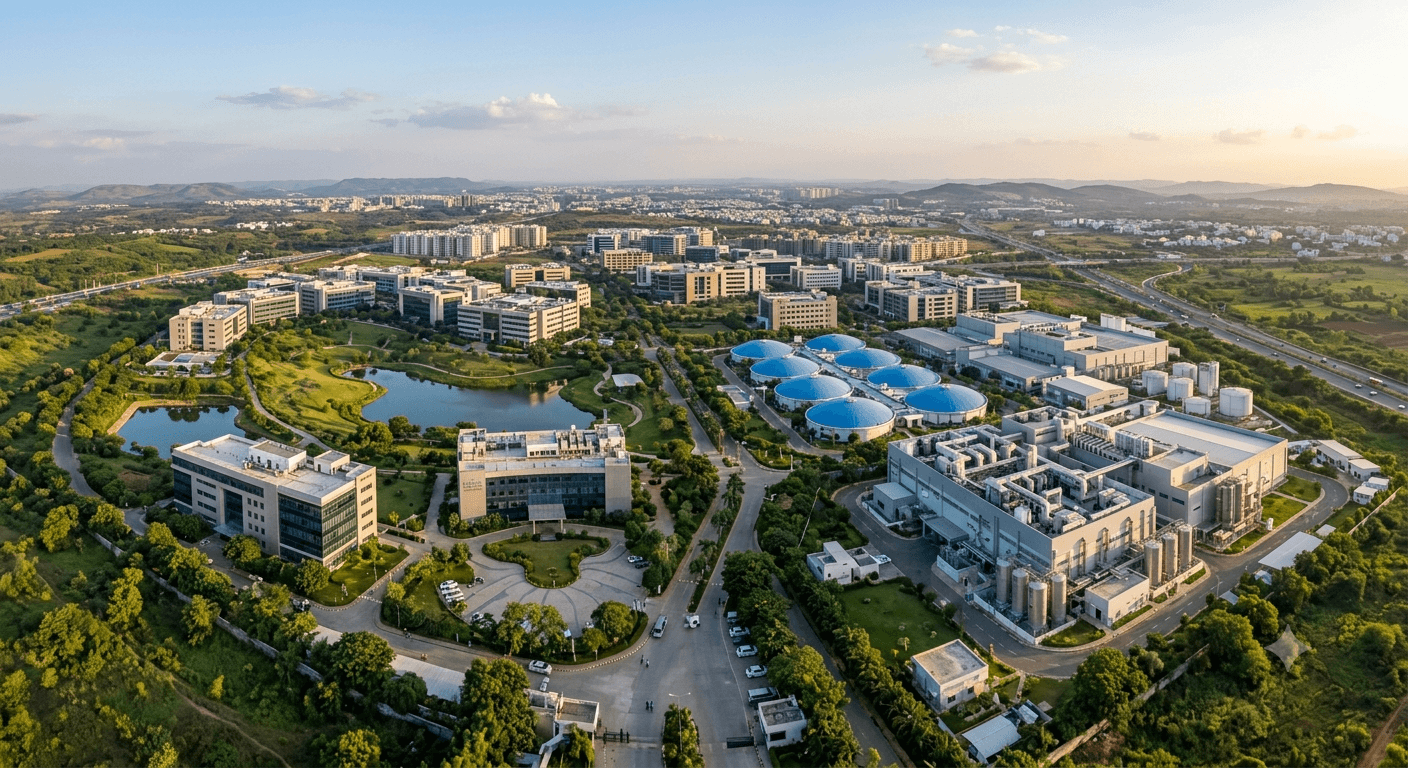
Genome Valley to Medical Devices Park: The Life Sciences Corridor Driving North Hyderabad Property Growth

Written by VMR BUILDCON
VMR Buildcon brings over 20 years of construction expertise in delivering high-quality turnkey projects for reputed real estate developers across Hyderabad, Bangalore, Mumbai, Vapi, and other key growth markets in India. With a strong foundation in structural excellence, engineering precision, and timely project execution.
The company has earned a reputation for reliability, quality craftsmanship, and construction integrity within the industry. Leveraging two decades of hands-on experience in large-scale residential developments, VMR Buildcon has now launched its own premium residential project in Gowdavalli near Kompally, Outer Ring Road, Hyderabad — a rapidly emerging real estate corridor known for strong infrastructure growth and long-term investment potential.
Backed by deep on-ground market knowledge, VMR Buildcon shares expert insights on Hyderabad real estate trends, gated community developments, construction quality benchmarks, legal documentation processes, and strategic property investment planning. The company follows transparent development practices, with RERA registration currently under process for its ongoing project.
VMR Buildcon remains committed to delivering thoughtfully planned homes that combine modern architecture, strategic connectivity, sustainable development practices, and long-term value appreciation for homebuyers and investors.
When people talk about Hyderabad's rise as a global city, the conversation usually starts with HITEC City — the western tech corridor that houses Google, Microsoft, Amazon, and hundreds of global capability centres. That story is well known.
But there is a parallel story unfolding 35 km to the north. Quieter, less photographed, and arguably more consequential for the long-term shape of this city.
In the Shamirpet-Kompally-Medchal corridor — the same corridor where VMR Buildcon's upcoming residential project in Gowdavalli is located — two of India's most strategically important industrial parks have been operating and growing for over two decades. Genome Valley, located at Shamirpet, is Asia's largest life sciences cluster and the reason Hyderabad is known as the vaccine capital of the world. The Medical Devices Park at Sultanpur is India's largest medtech manufacturing hub, exporting surgical devices and stents to 89 countries. Together, these two parks employ tens of thousands of qualified scientific and medical technology professionals — all of whom need homes within a reasonable commute of where they work.
This article tells that story — with verified facts, real employment data, and a clear picture of what Genome Valley and the Medical Devices Park mean for North Hyderabad's residential real estate in 2026.
A Personal Connection to This Story
VMR Buildcon's Director, Shashidhar Kanukolanu, brings a perspective on Genome Valley that few in Hyderabad's real estate industry can claim. He served as Chief Financial Officer with the Shapoorji Pallonji Group during the founding development of Genome Valley — one of the three original private sector partners, alongside the then-Andhra Pradesh government and Bharat Biotech, who built the cluster from the ground up beginning in 1999.
In other words, one of the people who helped build Genome Valley is now building homes for the professionals who work there.
That is not a marketing line. It is a factual statement about the depth of expertise that VMR Buildcon brings to understanding this corridor — its infrastructure, its employment profile, its long-term growth trajectory, and why residential demand in the Kompally-Gowdavalli zone is as well-founded as any in Hyderabad.
North Hyderabad's Life Sciences Corridor: By the Numbers
200+ Companies Genome Valley — 18 countries represented | 15,000+ Scientific Jobs Direct qualified workforce as of 2025 | 11 Billion Vaccine Doses Produced annually from Hyderabad |
302 Acres Medical Devices Park India's largest medtech cluster | Rs. 1,500 Cr Investment Committed to Medical Devices Park | 7,000+ Direct Jobs From Medical Devices Park alone |
Genome Valley: How North Hyderabad Became the Vaccine Capital of the World
The idea of Genome Valley was born in 1999 — conceived by Dr. Krishna Ella, the founder of Bharat Biotech, who proposed a dedicated hub where life sciences research, development, and manufacturing could co-exist in a single planned cluster. At a time when India's pharmaceutical industry was scattered and unorganised, this was a genuinely visionary idea.
The Andhra Pradesh government (now Telangana) formally designated 1,283 acres in Shamirpet, Medchal-Malkajgiri district in 2001. Today, that cluster has grown to 2,000 acres across Phase I, Phase II, and Phase III, and has become something no one fully anticipated in 1999: the single largest source of vaccine doses on the planet.
What Genome Valley Has Become
Metric | Figure | Context |
Total Area | 2,000 acres | Across 3 phases; Shamirpet, Medchal-Malkajgiri district |
Companies Hosted | 200+ from 18 countries | Including 6 of the world's top 10 R&D firms |
Scientific Workforce | 15,000+ professionals | Qualified scientists, researchers, and life sciences staff |
Vaccine Output | 11 billion doses annually | ~33% of global vaccine supply |
India's Pharma Output | One-third of global generics | Hyderabad accounts for this share by volume |
Distance from Gowdavalli | ~15 km via NH 44 / ORR | Shamirpet (Genome Valley Phase I & II) |
These are not aspirational targets. As of mid-2025, Hyderabad — with Genome Valley at its core — was confirmed by Telangana Life Sciences CEO Shakthi Nagappan as producing over 11 billion vaccine doses annually. The cluster has been certified by the United States Patent and Trademark Office and the European Union, and houses facilities from pharmaceutical multinationals operating on every continent.
Global Companies with a Presence in Genome Valley
The roster of companies operating out of Genome Valley reads like a who's who of the global life sciences industry. Below is a representative list of established companies with verified operations there:
Company | Sector | Presence at Genome Valley |
Bharat Biotech | Vaccine manufacturing, cell & gene therapy | India's most prolific vaccine maker; COVAXIN, Rotavac, Typhoid Vi; $75M CGT plant (2025) |
Biological E. Limited | Vaccine & biologics manufacturing | India's first private biologics company; pediatric vaccines, COVID vaccines |
Dr. Reddy's Laboratories | Biopharma finished dosage, R&D | One of India's largest pharma companies; global generics leader |
Novartis | Pharmaceutical R&D | Swiss global pharma major; R&D operations at Neovantage Innovation Parks |
GlaxoSmithKline (GSK) | Vaccine development | British pharma giant; vaccine R&D collaboration |
Mylan (now Viatris) | Biologics R&D | First biologics R&D laboratory in India established here |
Sai Life Sciences | Drug discovery CRO | Leading CRO for global pharma; molecule discovery services |
Syngene International | Integrated CRO/CDMO | Research and development services for global innovators |
Aurigene Discovery Technologies | Drug discovery | Oncology and inflammation-focused biotech |
Miltenyi Biotec | Cell & gene therapy | India's first CGT Centre of Excellence (2024); CAR-T manufacturing |
Yapan Bio | Viral vector biologics CDMO | Viral vectors, gene therapies, monoclonal antibodies; Piramal-backed |
Lonza | CDMO / manufacturing | Swiss global CDMO; Genome Valley operations |
Ferring Pharma | Reproductive health, urology | Swiss multinational; reproductive healthcare development planned |
DuPont / Ashland | Specialty chemicals / pharma | Materials and ingredient supply for pharma manufacturing |
Innovations Coming Out of Genome Valley (2024-2026)
The cluster has moved well beyond generic pharmaceutical manufacturing. These are verified innovation milestones from recent years:
Bharat Biotech launched India's first cell and gene therapy (CGT) and viral vector production plant at Genome Valley in early 2025, with a US $75 million investment. The facility produces GMP-grade adeno-associated virus (AAV), lentiviral, and adenoviral vectors — the core components of next-generation cancer and genetic disorder treatments.
Miltenyi Biotec opened India's first CAR-T Cell Therapy Centre of Excellence at Genome Valley in 2024 — positioning Hyderabad at the frontier of personalised cancer immunotherapy.
PopVax, a Hyderabad-based biotech startup, won a $2 million BARDA award in January 2025 for a self-administered influenza vaccine delivered via a microneedle patch, based on mRNA technology developed in Hyderabad.
Indian Immunologicals is conducting trials for India's first indigenous dengue vaccine (licensed from the US National Institutes of Health), with Phase I complete and Phase II/III underway.
Yapan Bio has been developing viral vector vaccines and gene therapies since 2019 at Genome Valley, now backed by Piramal Pharma, serving global pharma clients for biologics manufacturing.
Bharat Biotech's COVAXIN, developed and produced at Genome Valley, received WHO Emergency Use Listing and was deployed across India and 30+ countries during the COVID-19 pandemic.
Why This Matters Globally Genome Valley produces approximately one-third of the world's vaccine supply. When the COVID-19 pandemic hit, facilities in this cluster ramped up production to supply billions of doses globally. The Telangana Life Sciences Vision 2030 targets a life sciences market value of $120 billion, with 400,000 new jobs to be created — placing this corridor at the centre of one of the world's most important industrial growth stories. |
Genome Valley 2.0: The Next Chapter
The Telangana government has commissioned a Regional Master Plan for Genome Valley 2.0, developed by globally recognised master planners Jurong Consultants India (part of Singapore-based Surbana Jurong). The vision reframes Genome Valley from an industrial park into an integrated knowledge city — with residential districts, green corridors, transit-oriented development, and self-sufficient ecosystems for living, working, and research.
The 2.0 plan specifically calls out the need to provide residential options closer to workplaces for the growing scientific workforce — a direct acknowledgement that the 15,000+ professionals currently commuting to Genome Valley need quality housing in the North Hyderabad corridor.
Medical Devices Park, Sultanpur: Where India's Medical Technology Is Being Made
While Genome Valley gets the global headlines, the Medical Devices Park at Sultanpur in Patancheru, Sangareddy district is India's most important manufacturing cluster for medical devices — the hardware of healthcare.
Launched in June 2017 by the Telangana State Industrial Infrastructure Corporation (TSIIC), the 302-acre park was India's largest dedicated medtech cluster at inception, and has only grown more significant since. In less than a decade, it has transformed from a plot of developed industrial land into a cluster that exports 'Made in Telangana' medical devices to 89 countries.
Medical Devices Park: The Key Facts
Metric | Figure | Note |
Location | Sultanpur, Patancheru, Sangareddy district | Near ORR Exit 4A; ~50 km from Gowdavalli via ORR |
Total Area | 302 acres | India's largest dedicated medtech cluster |
Companies Operational | 65+ | Manufacturing and R&D units |
Total Investment | ~Rs. 1,500 crore | Committed across all operational companies |
Direct Employment | 7,000+ jobs | With 8,000+ indirect jobs in the ecosystem |
Export Reach | 89 countries | Including USA, Europe, Japan, Australia, New Zealand |
Flagship Achievement | Asia's largest stent facility | 1 million stents + 1.25 million balloon catheters annually |
What's Being Made Here
The breadth of medical devices being manufactured at Sultanpur has expanded dramatically since 2017. Products now include:
Coronary stents and balloon catheters — Asia's largest single facility (SMT — Sahajanand Medical Technologies), exporting to 89 countries
Ophthalmic devices — intraocular lenses, surgical instruments for eye care
Orthopaedic implants — bone screws, plates, joint replacement components
Prosthetics and advanced surgical devices
Ultrasound scanners and diagnostic imaging equipment
Single-use sterile kits, IV lines, and disposable surgical equipment
Dental and maxillofacial implants
Hospital HVAC (Protective Environment Control) systems
Disinfection equipment, protective gear
The 'Made in Telangana' stent produced at Sultanpur's SMT facility — which holds Asia's largest coronary stent production capacity at a million stents per year — now equips cardiac catheterisation labs not just across India but in hospitals from Tokyo to Sydney to New York.
Companies Operational at the Medical Devices Park
Company | Specialty / Product Focus |
SMT (Sahajanand Medical Technologies) | Asia's largest coronary stent and balloon catheter manufacturer; global exports |
Promea Therapeutics | Advanced therapeutics and diagnostics manufacturing |
Huwel Life Sciences | Specialised medical device R&D and manufacturing |
Akriti Oculoplasty | Ophthalmic and oculoplastic surgical devices |
Arka Engineers (Arka Medical Devices) | Precision medical equipment and device manufacturing |
SVP Techno Engineers | Medical device components and precision engineering |
Elvikon | Medical electronics and surgical equipment |
Rees Medilife | Sterile medical devices and hospital supplies |
Virchow Biotech | Pharmaceutical and biotech devices |
Medtronic | Global medical technology leader; investment in the Hyderabad ecosystem |
B-Braun | German medical technology giant; operations in the cluster |
The Asia-Pacific Connection The Medical Devices Park at Sultanpur is home to SMT's coronary stent facility — Asia's largest. Every year, a million stents and 1.25 million balloon catheters produced here are implanted in cardiac patients across 89 countries. This is not aspirational — it is active export production that makes North Hyderabad part of the global healthcare supply chain. |
Why Gowdavalli Sits at the Centre of This Story
Gowdavalli is not adjacent to one of these parks. It is geographically positioned between both of them — on the NH 44 / Outer Ring Road corridor that connects the two clusters.
Destination | Approx Distance | Commute Note |
Genome Valley (Phase I & II, Shamirpet) | ~15 km | Via NH 44 northward; ~20-25 min commute |
Medical Devices Park (Sultanpur, Patancheru) | ~50 km | Via ORR; ~35-45 min commute |
Kompally (established residential corridor) | ~5 km | Immediate social infrastructure backstop |
Secunderabad Junction | ~25 km | Via NH 44 |
HITEC City | ~40 km | Via ORR western arc |
For the 15,000+ scientific professionals employed at Genome Valley — researchers, scientists, regulatory affairs specialists, biotech engineers — the Kompally/Gowdavalli corridor is the nearest established residential zone with good infrastructure, schools, hospitals, and ORR connectivity. Most Genome Valley employees working in Shamirpet cannot reasonably commute from the western or southern zones of Hyderabad. They live in the north.
The Telangana government's own Genome Valley 2.0 Master Plan specifically identifies the need for residential development closer to the cluster as a strategic priority — to reduce commute times and improve talent retention for life sciences companies. Gowdavalli, sitting between these two parks and next to Kompally, directly addresses this stated infrastructure need.
The IT Parallel The rise of Genome Valley in North Hyderabad follows a strikingly similar trajectory to the rise of HITEC City in the west corridor. As HITEC City grew through the 2000s, residential prices in Gachibowli, Kondapur, and Manikonda rose dramatically because the working population needed to live close to work. Genome Valley's 15,000+ scientific workforce is creating the same gravitational pull on the north corridor — but with a 20-year head start already built into the cluster's size and global standing. The residential price appreciation in North Hyderabad has been significant — Kompally alone has seen 65%+ appreciation over 5 years. Gowdavalli, at the earlier stage of this cycle, offers entry into the same story before the next phase of price discovery. |
What This Means for Property Buyers in North Hyderabad
Industrial parks create residential demand. That's not a real estate opinion — it's an observable pattern that has played out in every major Indian city where industry preceded residential development.
Employment drives rental demand
With 15,000+ scientific professionals at Genome Valley and 7,000+ at the Medical Devices Park — a combined workforce of over 22,000 qualified professionals — the north corridor has a structural, sector-independent demand driver that is unrelated to IT market cycles. Pharma and life sciences employment is characterised by long tenure, high qualifications, and above-average salaries — making these professionals reliable tenants and buyers.
Life sciences employment is recession-resistant
Unlike IT employment, which fluctuates with global tech cycles, life sciences employment in vaccine production, medical device manufacturing, and pharmaceutical R&D is driven by healthcare demand — which grows with population and does not contract during economic slowdowns. This gives the north corridor a fundamentally different and more stable demand base than purely IT-driven western corridors.
Infrastructure follows employment
The government's Rs. 2,000 crore investment in Genome Valley 2.0, the ongoing demand for expansion at the Medical Devices Park, the ORR connectivity, and the NH 44 widening are all infrastructure investments that follow the employment cluster — and that infrastructure investment makes the residential corridor more liveable and more valuable over time.
Property price appreciation evidence
The data supports the thesis. Kompally, the established residential zone immediately adjacent to the Genome Valley commute corridor on NH 44, has seen property appreciation of 59.5–65.8% over five years. Gowdavalli, newer and closer to the ORR, is entering the residential market at a lower price point — the same position Kompally occupied roughly 7–8 years ago.
Vision 2030: The Next Phase of Growth
The scale of ambition for this corridor over the coming 4 years is significant. The Telangana government's Life Sciences Vision 2030 sets targets that — if even partially achieved — would dramatically change the residential demand picture in North Hyderabad:
Target: Life sciences market value of $120 billion (Telangana's share: 40%, i.e., $48 billion)
Employment: 400,000 new jobs to be created in the life sciences sector by 2030
Genome Valley 2.0 Regional Master Plan: Developing the cluster as an integrated residential and commercial city, not just an industrial zone
Medical Devices Park expansion: Plans to add 300-400 additional acres adjacent to Sultanpur
Bharat Biotech's new CGT plant ($75 million, 2025): More investment, more high-value employment
Global recognition: CBRE's 2025 report identified Genome Valley as one of the world's most dynamic life sciences clusters
Even under a conservative scenario — where 50% of these targets materialise — the employment growth in the north corridor between now and 2030 would represent tens of thousands of additional qualified professionals needing housing within reasonable commute distance of Shamirpet and Sultanpur.
VMR Buildcon's Upcoming Residential Project in Gowdavalli VMR Buildcon's upcoming residential project is located in Gowdavalli near Kompally — approximately 15 km from Genome Valley's Shamirpet campus via NH 44, and on the ORR corridor connecting to the Medical Devices Park. The project is currently in the pre-launch phase and will receive full RERA registration before any bookings are opened. For expressions of interest and project updates: Call or WhatsApp +91 922 330-9999 | Visit vmr.in | Email info@vmrbuildcon.com |
Disclaimer: This article is intended as an informational market overview for property buyers and investors in North Hyderabad. It does not constitute investment advice. All figures are approximate and sourced from the references cited above. Property price appreciation data is based on publicly available market research as of mid-2026. Readers are advised to conduct independent due diligence before making any investment decision. VMR Buildcon's upcoming project in Gowdavalli is in pre-launch; full RERA registration details will be shared once approvals are received
Frequently asked questions
Genome Valley is located in Shamirpet, in the Medchal-Malkajgiri district of Telangana, approximately 35 km north of central Hyderabad and 30 km from Secunderabad Junction. The cluster spans 2,000 acres across three phases, with Phase I and Phase II concentrated around Shamirpet and Turkapally, and Phase III approximately 11 km further in Karkapatla.
As of 2025, Genome Valley hosts more than 200 companies from 18 countries, including six of the world's top 10 pharmaceutical R&D firms and three of India's largest vaccine manufacturers (Bharat Biotech, Biological E, and Indian Immunologicals). Major companies include Bharat Biotech, Biological E, Dr. Reddy's Laboratories, Novartis, GlaxoSmithKline, Mylan/Viatris, Sai Life Sciences, and Syngene International.
As of mid-2025, Hyderabad produces over 11 billion vaccine doses annually — accounting for approximately one-third of the world's total vaccine supply. Genome Valley's production facilities, led by Bharat Biotech and Biological E, are the primary source of this output.
The Medical Devices Park is a 302-acre industrial cluster at Sultanpur, Patancheru, in Sangareddy district — India's largest dedicated medtech manufacturing and R&D hub. Inaugurated in 2017 by TSIIC, it hosts 65+ companies with a total investment of approximately Rs. 1,500 crore and over 7,000 direct jobs. Products manufactured here are exported to 89 countries.
Gowdavalli is positioned approximately 15 km from Genome Valley via NH 44 and on the ORR corridor — making it one of the closest established residential zones to the Genome Valley and Medical Devices Park employment clusters. With 22,000+ qualified professionals employed across both parks, there is structural residential demand in this corridor. Gowdavalli currently offers lower entry prices than the more established Kompally (which has seen 65%+ appreciation over 5 years), presenting an early-stage opportunity in the same demand corridor.
Genome Valley 2.0 is the Government of Telangana's vision to transform the existing Genome Valley industrial cluster into a fully integrated, self-sufficient life sciences city with residential districts, transit-oriented infrastructure, green corridors, and 24/7 ecosystem services — moving beyond a pure manufacturing zone. The Regional Master Plan was developed by Singapore-based master planners Jurong Consultants India (Surbana Jurong).