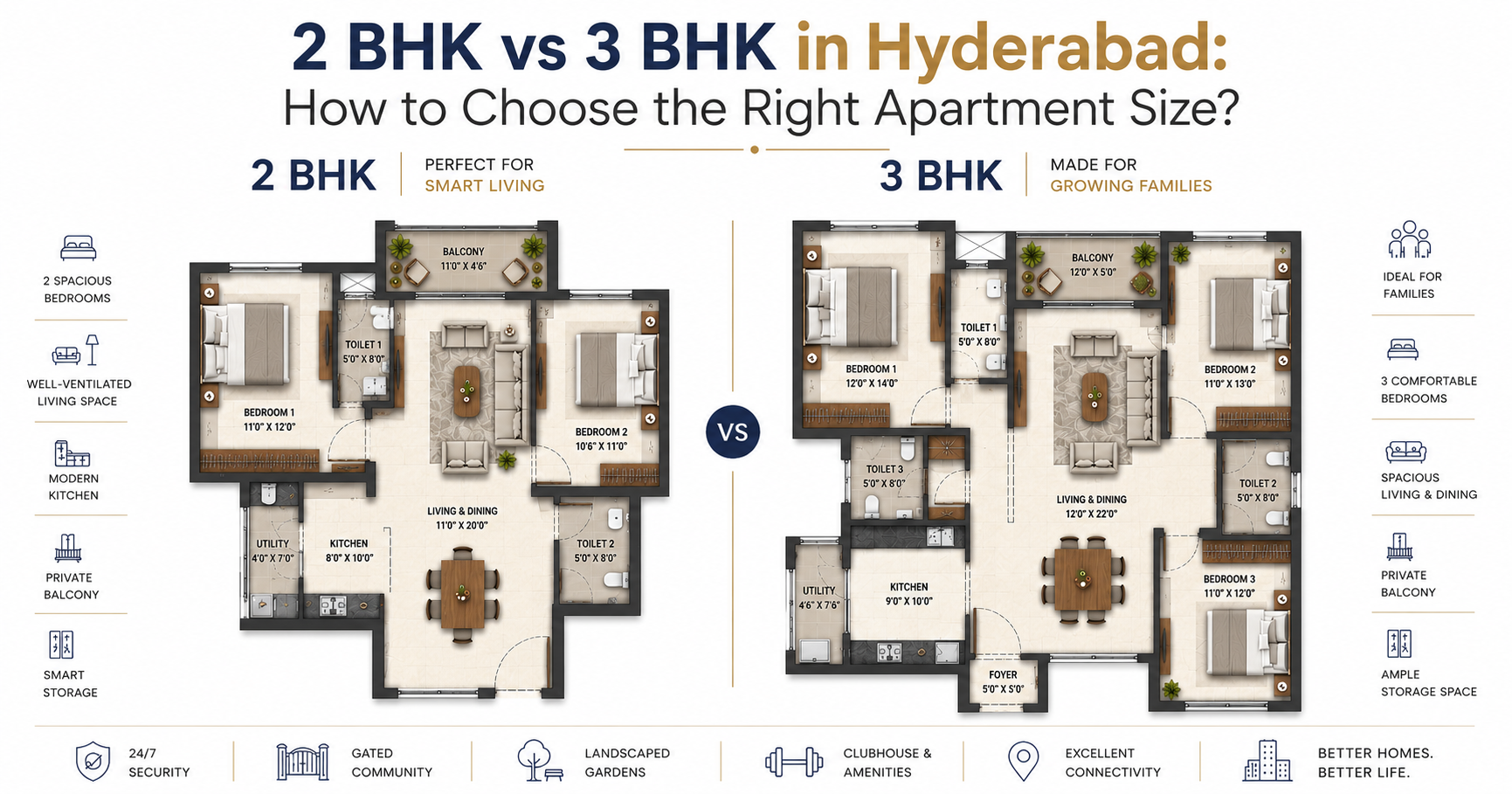
2 BHK vs 3 BHK in Hyderabad: How to Choose the Right Apartment Size in 2026

Written by Vuddar Madhava Rao
Vuddar Madhava Rao is the Founder and Managing Director of VMR Buildcon, a Hyderabad-based real estate developer and turnkey construction company. Since founding VMR Buildcon in January 2000, he has led the delivery of premium residential and commercial projects across Hyderabad, Bangalore, Mumbai, and Vapi — first as a turnkey contractor for established real estate developers, and since 2018 as the developer of VMR Buildcon's own residential community projects.
With over 26 years in construction and real estate, Madhava Rao has built a reputation for engineering precision, on-time delivery, and uncompromising quality standards. Projects delivered under his leadership include Mulberry Meadows, Sai Nest, Sarthak, Fortune Meadows, Westend Meadows, Ipsit Anand Mangal (Borivali West, Mumbai), 21 Square (Borivali West, Mumbai), Satyam II (Malad East, Mumbai), Marquis (Malad West, Mumbai), and Golden Gateway (Borivali East, Mumbai), among others.
VMR Buildcon's current flagship own-development upcoming project is Near Kompally — a 6.75-acre gated community in Gowdavalli, North Hyderabad, that synthesises two and a half decades of construction lessons into a single premium residential development. The project is curated in collaboration with renowned architect Niroop Kumar Reddy.
Beyond VMR Buildcon, Madhava Rao founded Subcontracts.in in 2017 — a civil and infrastructure works contracting and PMC consulting business serving the industrial, warehousing, textiles, IT, tourism, hospitality, and renewable energy sectors across India. He is also the Managing Director of Motoron Automotive Lubricants Pvt Ltd.
Beyond execution, Madhava Rao is an active voice in Hyderabad's real estate market commentary, regularly publishing analysis on Medium and LinkedIn covering North Hyderabad's infrastructure-led growth, the impact of the Kandlakoya IT Park on residential pricing, and the emergence of the Gowdavalli–Kompally corridor as Hyderabad's next premium residential destination.
"Building dreams. Delivering trust. Over two and a half decades at the foundation of Hyderabad real estate."
Education
• Bachelor of Science (BS), Computer Science — Osmania University, Hyderabad (1993–1996)
• Government Model Basic High School, Mahabubnagar, Andhra Pradesh
Languages
English · Hindi · Telugu · Kannada
Areas of Expertise
• Residential real estate development
• Turnkey construction and project management
• Gated community planning and execution
• Hyderabad real estate market analysis
• Construction quality systems and engineering precision
• Civil and infrastructure works contracting (PMC consulting)
• Multi-city project delivery — Hyderabad, Bangalore, Mumbai, Vapi
Other Leadership Roles
• Founder & Principal Consultant, Subcontracts.in (August 2017 – present) — Civil & infrastructure works contracting and PMC consulting
• Managing Director, Motoron Automotive Lubricants Pvt Ltd (June 2017 – present)
Connect
• LinkedIn: https://in.linkedin.com/in/vmadhavarao (32,000+ followers)
• VMR Buildcon: https://vmr.in
• Medium: https://vmrbuildcon.medium.com
• Subcontracts.in: https://www.subcontracts.in
In His Own Words
"Every home we deliver carries the trust of families who place their future in our hands. At VMR, our commitment is to quality, transparency and lasting value."
— Vuddar Madhava Rao
When you're buying an apartment in Hyderabad, the size question — 2 BHK or 3 BHK — usually decides itself faster than buyers expect. The hard part is being honest about which one should decide it. Most buyers overweight the immediate budget difference (₹15 to 25 lakh, typically) and underweight five things that compound over the next decade: family size growth, work-from-home permanence, resale liquidity, rental dynamics, and the very expensive cost of upgrading from a 2 BHK to a 3 BHK later.
This guide takes both options seriously, with current 2026 Hyderabad pricing, a worked example from the Kompally market, and a clean decision framework you can apply to your own situation. As a developer building in the Kompally corridor, we get the 2 BHK vs 3 BHK question more than almost any other — so this is the answer we'd give a buyer sitting across the table.
The 2 BHK in Hyderabad: Who It Suits and What You Get
A 2 BHK apartment in a modern Hyderabad gated community typically runs 1,100 to 1,300 square feet of saleable area — two bedrooms, two bathrooms, a living-dining space, kitchen, and one or two balconies. In older buildings or budget-segment projects, you'll find 2 BHKs as small as 950 sqft. In premium gated communities, configurations stretch to 1,400+ sqft with a study nook or utility room.
Who 2 BHKs typically suit
First-time buyers under 35, often a couple without children or with one young child
Single-income or budget-conscious dual-income households
Buyers prioritising location over size — willing to take a 2 BHK in HITEC City or Gachibowli rather than a 3 BHK in a farther corridor
Investors looking for higher rental yield percentage (more on this below)
Empty-nesters downsizing from older 3 BHK independent houses
The trade-offs you'll notice over time
A 2 BHK works beautifully for the first 3 to 5 years. The stress points show up later: a second child, ageing parents who need to visit or move in, a permanent home-office setup, or simply more belongings than the layout was designed for. None of these are dealbreakers — millions of families live happily in 2 BHKs — but they're the honest pressure points worth pricing into the decision.
The 3 BHK in Hyderabad: Who It Suits and What You Get
A 3 BHK apartment in a modern Hyderabad gated community typically runs 1,500 to 1,800 square feet of saleable area — three bedrooms (often with one as a master suite with attached bath), two to three bathrooms, larger living-dining, kitchen with utility, and usually two balconies. Premium configurations push to 2,000+ sqft with a servant room.
Who 3 BHKs typically suit
Families with two children, or one child and parents who visit or live with them
Households with one or two members regularly working from home
Buyers in the upgrade cycle — moving from an older 2 BHK or independent house
NRI buyers, who tend to default to 3 BHK regardless of family size (for resale liquidity and family visits)
Long-horizon buyers planning to live in the home 10+ years
The trade-offs
The extra room comes with extra cost — typically ₹20 to 28 lakh more in upfront cost — plus higher maintenance charges (proportional to area), higher property tax, and the obvious: that third room often becomes a storage space if it's not actively used. The buyers who get the most from a 3 BHK are those who would actually utilise the third room — for kids, parents, home-office, or guests at least weekly.
Price Comparison: What 2 BHK and 3 BHK Actually Cost in 2026
The per-sqft price is identical between a 2 BHK and 3 BHK in the same project — developers don't price by configuration, they price by area. So the price difference flows entirely from the saleable-area difference, typically 400 to 600 sqft more in a 3 BHK.
Here's how the math works at 2026 Kompally pre-launch pricing of ₹5,000 per sqft:
Cost Component | 2 BHK (1,200 sqft) | 3 BHK (1,650 sqft) |
Base property price | ₹60,00,000 | ₹82,50,000 |
GST (5%) | ₹3,00,000 | ₹4,12,500 |
Stamp duty + registration (~6%) | ₹3,60,000 | ₹4,95,000 |
Total acquisition cost | ₹66,60,000 | ₹91,57,500 |
Difference | — | +₹24,97,500 |
The honest gap: roughly ₹25 lakh more for a 3 BHK over a comparable 2 BHK in the same gated community. On premium ready-to-move inventory in Kompally at around ₹7,500 per sqft, the same gap stretches to roughly ₹37 lakh.
Hidden incremental costs on a 3 BHK
Three carrying costs most buyers don't model:
Monthly maintenance: roughly ₹5/sqft × extra 450 sqft = about ₹2,250 more per month, or ₹27,000 a year
Home loan EMI on the extra ~₹22 lakh: roughly ₹19,000 to ₹20,000 more per month at current rates
Interior fitout: an extra room means an extra ₹2 to ₹4 lakh in furniture, fittings, and finishing
The 3 BHK costs about ₹2.5 lakh per year more to own, on top of the higher upfront price. Worth knowing if your monthly cash flow is tight.
Resale Value: Which Holds Up Better in Hyderabad?
This is where Hyderabad's specific market dynamics matter. Hyderabad is a family-buyer market — most demand in the resale market comes from upgrade buyers (moving from 1 BHK or 2 BHK to 3 BHK) or first-time buyers stepping into ownership. Investor flips are a smaller share than in Mumbai or Gurgaon.
3 BHK resale pattern in Hyderabad
3 BHKs typically appreciate at the broader market rate — 8 to 12% annually in healthy sub-markets, higher in growth corridors like Kompally and Gowdavalli — and find buyers within 60 to 120 days in most established localities. The buyer pool is large and consistent: families upsizing, NRIs, joint households. In premium gated communities, 3 BHK inventory often sells out before 2 BHK in the same project.
2 BHK resale pattern in Hyderabad
2 BHKs appreciate at similar rates but show stronger demand-driven pricing in IT-corridor localities (Gachibowli, Kondapur, Madhapur, HITEC City) where investor and rental-purpose buyers add to family demand. In family-focused corridors like Kompally or Bachupally, 2 BHK demand is thinner — most local buyers want at least a 3 BHK. So 2 BHK resale liquidity is location-sensitive in a way 3 BHK liquidity isn't.
The takeaway
3 BHK = better resale liquidity across all Hyderabad sub-markets
2 BHK = good resale in IT corridors, slower in family corridors
If you're buying in Kompally, Gowdavalli, or other North or East Hyderabad corridors, a 3 BHK gives you a meaningfully larger resale buyer pool
Rental Yield: 2 BHK vs 3 BHK in Hyderabad
This is where the math flips. 2 BHKs almost always deliver a higher rental yield percentage than 3 BHKs — though the absolute rent is lower.
Typical 2026 rental ranges in major Hyderabad sub-markets:
Locality | 2 BHK Rent (₹/month) | 3 BHK Rent (₹/month) |
HITEC City / Madhapur | 28,000 – 40,000 | 45,000 – 65,000 |
Gachibowli | 25,000 – 35,000 | 40,000 – 55,000 |
Kondapur | 22,000 – 32,000 | 35,000 – 48,000 |
Kompally / Bachupally | 18,000 – 25,000 | 25,000 – 35,000 |
Kokapet | 28,000 – 42,000 | 50,000 – 75,000 |
Across these localities, 2 BHK gross rental yields typically run 3.0 to 3.5%, while 3 BHK yields run 2.5 to 3.0%. Net yields (after maintenance, property tax, and vacancy) run 0.5 to 0.8 percentage points lower.
Why 2 BHK yield is higher
2 BHK rent doesn't scale linearly with size. A 3 BHK with 50% more area doesn't command 50% more rent — it commands maybe 35 to 45% more. So on a per-square-foot basis, 2 BHKs out-earn 3 BHKs.
Why 3 BHK rent is more stable
3 BHKs attract longer-term tenants (families), lower turnover, fewer vacancy gaps. 2 BHKs have higher turnover (singles, couples, IT bachelors) but rarely sit vacant for long in IT corridors.
Investor takeaway
For pure yield-driven investment: 2 BHK in HITEC City, Gachibowli, or Kondapur
For low-maintenance, stable-tenant rental: 3 BHK in any well-located gated community
For families investing for eventual own use: 3 BHK in a growth corridor like Kompally
Lifestyle and Functional Considerations
The financial math is half the answer. The other half is about how you actually use the space — and how that changes over the 10 to 15 years you'll likely own this home.
Family size, now and in 5–10 years
If you're planning a second child, expecting parents to live with you, or have ageing in-laws who visit for extended periods, that third bedroom shifts from 'nice-to-have' to 'almost-required.' 2 BHKs work for a couple plus one child up to about age 8. Beyond that, kids need their own space, and the calculation usually changes.
Work-from-home reality
Post-pandemic, work-from-home or hybrid work has become permanent for a meaningful share of Hyderabad's IT workforce. If you or your spouse works from home even 2 to 3 days a week, that third room becomes a genuine office, not a luxury. Trying to work from a corner of the living room in a 2 BHK is sustainable for a year; for ten years, it isn't.
Guests, hospitality, family visits
Hyderabad and Telugu culture have a strong hospitality tradition — extended family visits, weddings, festivals all generate guests staying for days or weeks. A 3 BHK absorbs this comfortably; a 2 BHK doesn't, and the couch-as-guest-bed pattern wears thin over time.
Cars and parking
3 BHK allotments in gated communities typically come with two parking slots; 2 BHKs typically get one. If you have two earning members in the household and both drive, this is a meaningful daily issue.
Storage and utility
Indian families accumulate more household stuff than the typical floor plan accounts for — seasonal clothing, festival items, kitchen equipment, kids' supplies, ageing electronics. A 3 BHK's extra utility space and storage closets handle this; a 2 BHK gets cluttered quickly.
When 2 BHK Is the Smarter Choice
Choose 2 BHK if:
You're a couple without children, with no immediate plans for a child in the next 3 to 5 years
Your budget is genuinely capped — stretching to a 3 BHK would compromise your cash reserves, downpayment, or interior fitout budget
You're prioritising location over size — willing to take a 2 BHK in an IT corridor over a 3 BHK in a farther suburb
You're investing primarily for rental yield (2 BHKs out-yield 3 BHKs by roughly 0.5 to 1 percentage point)
You expect to upgrade within 5 to 7 years to a larger home as your situation changes — though see the next section on whether this strategy actually works financially
When 3 BHK Is the Smarter Choice
Choose 3 BHK if:
You have two children, or one child plus parents who visit or live with you regularly
Either you or your spouse works from home at least 2 to 3 days a week
You're an NRI or non-resident buyer — 3 BHKs have stronger resale liquidity and accommodate family visits during your trips
You're a long-horizon buyer planning to live in this home for 10+ years
You're buying in a family-focused corridor (Kompally, Bachupally, Gowdavalli, Suchitra) where 3 BHK resale demand is stronger than 2 BHK
You can comfortably afford the additional ~₹25 lakh upfront and the ~₹2.5 lakh per year higher carrying cost
You'd otherwise be planning an 'upgrade in 5 to 7 years' strategy (the math, below, often favours buying 3 BHK directly)
The 'Buy 2 BHK Now, Upgrade Later' Strategy — Does It Actually Work?
This is a popular plan: buy a 2 BHK now, then upgrade to a 3 BHK in 5 to 7 years when income and family size justify it. The strategy is intuitive but often financially worse than buying the 3 BHK directly. Here's why.
The hidden costs of the upgrade transaction
Stamp duty and registration on the new property: roughly 6% of the new property's value = ₹6 to ₹8 lakh on a typical upgrade
GST on the new (under-construction) property: 5% if you're upgrading to a new launch = another ₹4 to ₹5 lakh
Brokerage on the old property sale: 1 to 2% = ₹1 to ₹1.5 lakh
Tax on capital gains from the old property sale: depends on holding period and reinvestment timing
Lost rent or EMI overlap during the move-and-sell transition: typically 3 to 6 months of double carrying cost
Interiors and fitout for the new home: ₹6 to ₹10 lakh
Loss of established neighbourhood, schools, networks — non-financial but real
Estimated total cost of upgrading later: ₹20 to ₹30 lakh in transaction friction, on top of the property price difference itself. That's almost identical to the ~₹25 lakh price gap between a 2 BHK and 3 BHK today. So if you know you'll need a 3 BHK eventually, the upgrade path costs you the price difference twice — once in stamp duty and registration when you buy the 2 BHK, and again in transaction costs when you upgrade.
The honest verdict on the upgrade strategy
It works if your income trajectory is uncertain and you need to start small to qualify for the loan
It doesn't work as a 'save money now, upgrade later' plan — that math almost never pencils out
It can work if the 2 BHK you buy is in a corridor that will appreciate faster than where you'll eventually upgrade — but this requires speculation on micro-market timing
A Kompally Reference Point: VMR Kompally 2 BHK vs 3 BHK
For readers comparing 2 BHK vs 3 BHK in the Kompally market right now, VMR Kompally offers both configurations within the same gated community — useful because it lets you do the comparison on identical pricing, amenities, and location.
At current pre-launch pricing (₹5,000 per sqft):
2 BHK (~1,200 sqft): approximately ₹60 lakh base price, ₹66.6 lakh total acquisition cost
3 BHK (~1,650 sqft): approximately ₹82.5 lakh base price, ₹91.6 lakh total acquisition cost
Difference: roughly ₹25 lakh
Both configurations sit in the same 6.75-acre gated community — a 632-home development with 40+ amenities and adjacency to a 600-acre reserve forest. The decision becomes purely about family size, work-from-home reality, and long-term horizon, not about location or amenity trade-offs.
Explore configurations:
The Honest Verdict — Quick Decision Framework
Run yourself through this short test:
Will you have two children, or a parent living with you, within 5 years? → 3 BHK
Will you or your spouse work from home 2+ days a week? → 3 BHK
Is your household income trajectory predictable and you plan to live here 10+ years? → 3 BHK
Are you stretching financially even for the 2 BHK? → 2 BHK (stretch is real; don't compound it)
Are you buying purely for rental yield in an IT corridor? → 2 BHK
Are you NRI or non-resident? → 3 BHK almost always
If three or more answers point to 3 BHK, the math, lifestyle, and resale realities all favour going straight to 3 BHK rather than the 2 BHK-now-upgrade-later path.
Conclusion
The 2 BHK vs 3 BHK decision in Hyderabad isn't really about budget — it's about your 10-year picture. Buyers who choose well do it by being honest about how they actually live now and how they're likely to live in five years, then matching the apartment to that picture rather than to the current month's bank balance.
For most family buyers in growth corridors like Kompally, the 3 BHK math is stronger than the upfront price difference suggests — resale is more liquid, lifestyle flexibility is built in, and the transaction-cost avoidance compared to the upgrade path is significant. For couples, investors, and IT-corridor buyers prioritising yield, the 2 BHK still makes clean sense.
Whichever you choose, prioritise developer credibility (RERA registration plus delivery history) and corridor selection over headline price. A well-built 2 BHK in the right corridor will outperform a poorly-built 3 BHK in the wrong one — every time.
If you're weighing 2 BHK vs 3 BHK in the Kompally corridor specifically, VMR Kompally offers both configurations in the same gated community at pre-launch pricing — making the comparison clean across location, amenities, and timing. Explore the project →
Frequently asked questions
For most family buyers in Hyderabad, a 3 BHK is the better long-term choice — it has stronger resale liquidity, accommodates lifestyle changes (additional children, parents, work-from-home), and avoids the high transaction costs of upgrading later. A 2 BHK is the right choice for couples without children planning to upgrade within 3 to 5 years, single-income households with tight budgets, or pure rental-yield investors in IT corridors. The decision should turn on your 10-year horizon, not just current budget.
In the same project at the same per-sqft price, the difference flows from the area difference (typically 400 to 600 sqft). At 2026 Kompally pricing of ₹5,000 per sqft pre-launch, that translates to roughly ₹22 to ₹25 lakh in base property cost. After GST, stamp duty, and registration, the total acquisition cost gap widens to about ₹25 lakh. In premium ready-to-move inventory at ₹7,500 per sqft, the gap stretches to roughly ₹37 lakh.
3 BHKs typically have better resale liquidity across Hyderabad's sub-markets because the buyer pool — families upsizing, NRIs, joint households — is larger and more consistent. 2 BHK resale is strong specifically in IT corridors (Gachibowli, Kondapur, HITEC City, Madhapur) where investor and rental-buyer demand adds to family demand. In family-focused corridors like Kompally, Bachupally, and Gowdavalli, 3 BHK demand is meaningfully stronger than 2 BHK. Appreciation rates are similar between the two — the difference is in how quickly each finds a buyer.
2 BHKs deliver a higher rental yield percentage — typically 3.0 to 3.5% gross in IT corridors versus 2.5 to 3.0% for 3 BHKs in the same locality. But 3 BHKs have lower tenant turnover and longer vacancy-free periods because they attract family tenants. For pure yield-maximising investors, 2 BHK in an IT-adjacent locality wins. For stable, low-maintenance rental income, 3 BHKs are the better choice.
Generally yes, if you'll actually use the third room — for kids, parents, home-office, or regular guests. If it would mostly stay empty, the answer is no. The strongest financial argument for 3 BHK isn't appreciation (similar to 2 BHK) but transaction-cost avoidance: if you'd otherwise upgrade to a 3 BHK in 5 to 7 years, the transaction costs (stamp duty, GST, brokerage, fitout) typically match the ₹25 lakh price difference — making the direct purchase financially equivalent to the upgrade path, without the disruption.
In modern Hyderabad gated communities, 2 BHKs typically range from 1,100 to 1,300 sqft of saleable area, and 3 BHKs from 1,500 to 1,800 sqft. Premium configurations push beyond these bands — premium 2 BHKs with study reach 1,400+ sqft, and premium 3 BHKs with servant rooms reach 2,000+ sqft. Budget-segment projects offer smaller versions (2 BHKs as compact as 950 sqft, 3 BHKs as compact as 1,300 sqft).
Yes — and many do, especially NRIs, long-horizon buyers, and households planning a family within 2 to 3 years. The case for it: you avoid the disruption of upgrading later, you have flexibility for home-office or guests, and you get stronger resale liquidity. The case against it: you pay roughly ₹2.5 lakh per year more in carrying costs (maintenance, EMI, property tax) for space you may not fully use. If you'll grow into the space within 3 to 5 years, buy 3 BHK. If not, the 2 BHK math is cleaner.
The 'buy small, upgrade later' strategy looks financially smart but usually isn't. The transaction costs of upgrading (stamp duty + GST + brokerage + fitout + EMI-rent overlap during the move) typically total ₹20 to ₹30 lakh — nearly identical to the price gap between a 2 BHK and 3 BHK today. If you're confident you'll need a 3 BHK eventually, buying it directly avoids paying the gap twice. The upgrade path makes sense if your income trajectory is uncertain or if you genuinely don't know whether you'll need the extra space.