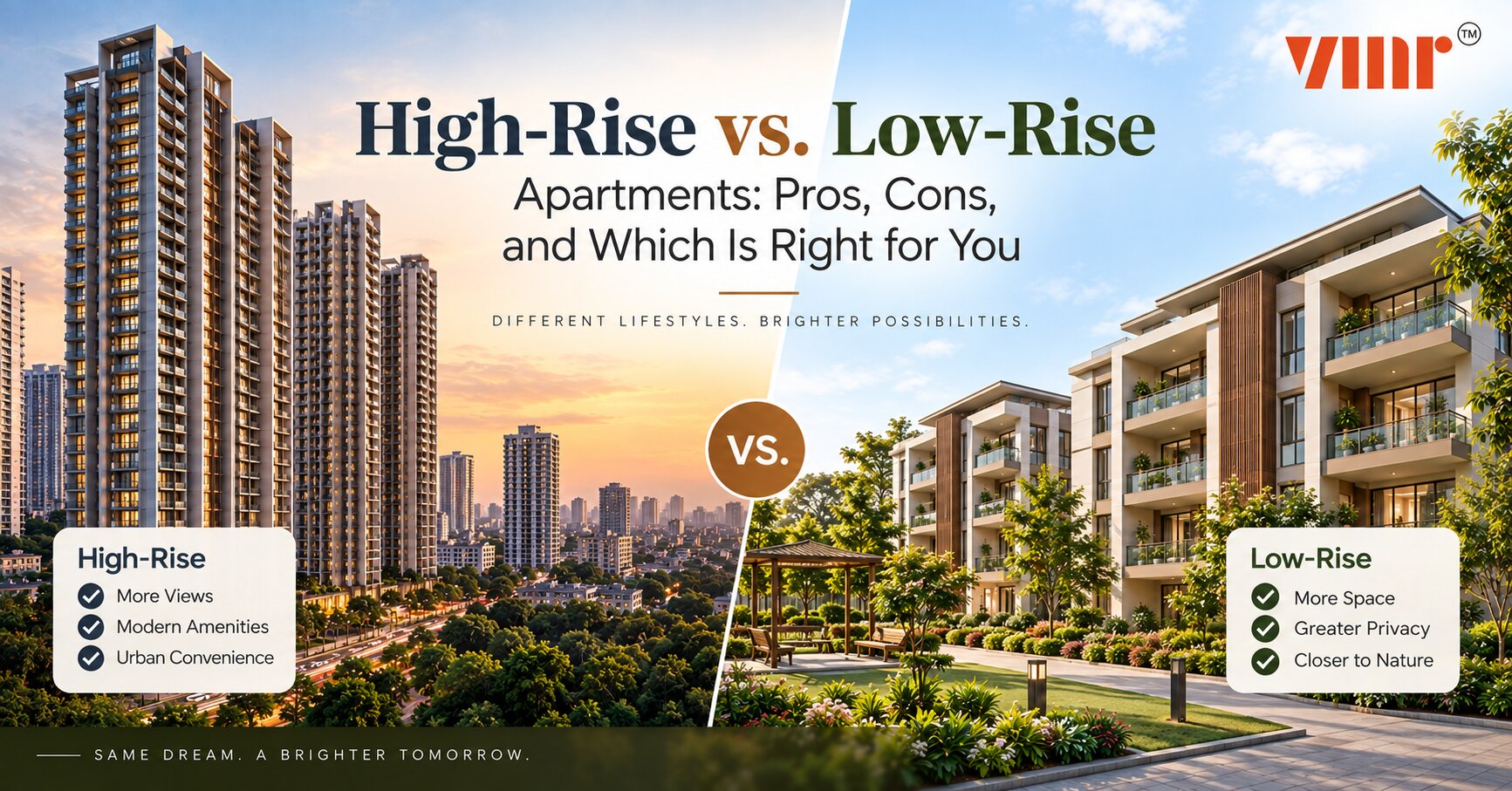
High-Rise vs. Low-Rise Apartments: Pros, Cons, and Which Is Right for You

Written by Vuddar Madhava Rao
Vuddar Madhava Rao is the Founder and Managing Director of VMR Buildcon, a Hyderabad-based real estate developer and turnkey construction company. Since founding VMR Buildcon in January 2000, he has led the delivery of premium residential and commercial projects across Hyderabad, Bangalore, Mumbai, and Vapi — first as a turnkey contractor for established real estate developers, and since 2018 as the developer of VMR Buildcon's own residential community projects.
With over 26 years in construction and real estate, Madhava Rao has built a reputation for engineering precision, on-time delivery, and uncompromising quality standards. Projects delivered under his leadership include Mulberry Meadows, Sai Nest, Sarthak, Fortune Meadows, Westend Meadows, Ipsit Anand Mangal (Borivali West, Mumbai), 21 Square (Borivali West, Mumbai), Satyam II (Malad East, Mumbai), Marquis (Malad West, Mumbai), and Golden Gateway (Borivali East, Mumbai), among others.
VMR Buildcon's current flagship own-development upcoming project is Near Kompally — a 6.75-acre gated community in Gowdavalli, North Hyderabad, that synthesises two and a half decades of construction lessons into a single premium residential development. The project is curated in collaboration with renowned architect Niroop Kumar Reddy.
Beyond VMR Buildcon, Madhava Rao founded Subcontracts.in in 2017 — a civil and infrastructure works contracting and PMC consulting business serving the industrial, warehousing, textiles, IT, tourism, hospitality, and renewable energy sectors across India. He is also the Managing Director of Motoron Automotive Lubricants Pvt Ltd.
Beyond execution, Madhava Rao is an active voice in Hyderabad's real estate market commentary, regularly publishing analysis on Medium and LinkedIn covering North Hyderabad's infrastructure-led growth, the impact of the Kandlakoya IT Park on residential pricing, and the emergence of the Gowdavalli–Kompally corridor as Hyderabad's next premium residential destination.
"Building dreams. Delivering trust. Over two and a half decades at the foundation of Hyderabad real estate."
Education
• Bachelor of Science (BS), Computer Science — Osmania University, Hyderabad (1993–1996)
• Government Model Basic High School, Mahabubnagar, Andhra Pradesh
Languages
English · Hindi · Telugu · Kannada
Areas of Expertise
• Residential real estate development
• Turnkey construction and project management
• Gated community planning and execution
• Hyderabad real estate market analysis
• Construction quality systems and engineering precision
• Civil and infrastructure works contracting (PMC consulting)
• Multi-city project delivery — Hyderabad, Bangalore, Mumbai, Vapi
Other Leadership Roles
• Founder & Principal Consultant, Subcontracts.in (August 2017 – present) — Civil & infrastructure works contracting and PMC consulting
• Managing Director, Motoron Automotive Lubricants Pvt Ltd (June 2017 – present)
Connect
• LinkedIn: https://in.linkedin.com/in/vmadhavarao (32,000+ followers)
• VMR Buildcon: https://vmr.in
• Medium: https://vmrbuildcon.medium.com
• Subcontracts.in: https://www.subcontracts.in
In His Own Words
"Every home we deliver carries the trust of families who place their future in our hands. At VMR, our commitment is to quality, transparency and lasting value."
— Vuddar Madhava Rao
Indicator | Low-Rise (G+3/G+4) | High-Rise (G+10 and above) |
Families per acre (industry benchmark) | ~30–50 | 100+ |
UDS per resident (same land parcel) | Proportionally larger | Proportionally smaller |
Elevator dependency | Minimal to none | High |
Typical CAM trend | Generally lower per-household load | Often higher, larger shared infrastructure |
Evacuation path length | Short | Longer, elevator-dependent |
Choosing between a high-rise and a low-rise apartment is one of the first real forks in the road for any Hyderabad homebuyer — and it shapes almost everything about daily life more than any single amenity on the brochure. A high-rise apartment typically sits in a tower of 10, 15, or more floors, while a low-rise apartment is usually built as G+3 or G+4 — four or six floors in total. That difference in scale drives density, and density drives nearly everything else: how many neighbours you share a clubhouse with, how much land you actually own under your unit, and how quickly you can get out in an emergency.
What Counts as High-Rise vs. Low-Rise?
A low-rise apartment building is typically constructed as G+3 or G+4 — ground floor plus three or four upper floors — while a high-rise tower commonly runs to 10, 15, or more floors. Mid-rise buildings, typically G+7 to G+9, sit between the two and share some characteristics of both — but the clearest lifestyle differences show up at the extremes, which is what this comparison focuses on.
Pros of High-Rise Apartments
Often better views and skyline access, especially on higher floors.
Frequently located in more established, centrally connected parts of the city, given the scale of investment high-rise development usually requires.
Larger developments can support a bigger on-site amenity list — multiple clubhouses, sports courts, larger pools — simply due to scale.
Per-square-foot pricing can sometimes be lower, since land cost is amortised across a much larger number of units.
Cons of High-Rise Apartments
Higher density means more households competing for the same clubhouse, gym, and pool slots — often requiring advance booking during peak hours.
A smaller proportional UDS (undivided share of land) per resident, since the same land parcel is divided among far more units.
Daily elevator dependency, with wait times that can stretch into several minutes during morning and evening rush.
More common-area vehicular traffic at entry gates and drop-off zones, particularly in towers with 1,000 or more units.
Reduced acoustic privacy, with more shared walls and higher foot traffic through corridors.
Longer, more elevator-dependent evacuation paths in an emergency.
Pros of Low-Rise Apartments
Lower density means amenities are typically available on demand rather than requiring booking.
A proportionally larger UDS per resident on comparable land, since fewer units share the same parcel.
Minimal to no elevator dependency for daily movement — and shorter, more direct evacuation routes in an emergency.
Quieter, more private day-to-day living, with greater physical separation between homes.
A better chance of building real familiarity with neighbours, since a smaller resident base shares the same spaces often enough to recognise each other — what sociologists call “social infrastructure.”
Typically more usable open and green space per resident, even when total green cover looks modest in absolute terms.
Cons of Low-Rise Apartments
Smaller-scale developments may offer a shorter on-site amenity list compared to large high-rise townships.
Low-rise communities are often concentrated in emerging growth corridors rather than already-established central neighbourhoods, which may mean a slightly longer commute today — though this can also mean getting in ahead of infrastructure-led appreciation.
Per-square-foot pricing can occasionally run higher, since land cost is spread across fewer total units.
High-Rise vs. Low-Rise: Side-by-Side Comparison
Factor | High-Rise Apartments | Low-Rise Apartments |
Density | Higher — more households per acre | Lower — fewer households per acre |
UDS per resident | Smaller, proportionally | Larger, proportionally |
Amenity access | Booking required, peak-hour waits | Typically on-demand |
Elevator dependency | High — daily wait times | Minimal to none |
Views / skyline access | Often better, especially higher floors | Limited, ground-level orientation |
Location profile | Often more central, established areas | Common in emerging growth corridors |
Community familiarity | Diluted, largely anonymous | Frequent repeat encounters with neighbours |
Typical CAM charges | Higher — larger shared infrastructure | Generally lower per household |
Evacuation / fire safety | Longer paths, elevator-dependent | Shorter, more direct evacuation routes |
Which Is Right for You?
Choose High-Rise If…
You prioritise a central location, want access to a very large on-site amenity list, and don't mind daily elevator use and some peak-hour amenity booking in exchange for those trade-offs.
Choose Low-Rise If…
You're buying for a family with young children or senior citizens, value privacy and quiet over amenity count, want a larger proportional UDS, or simply want to actually get to know your neighbours rather than share a building with a few thousand strangers.
A Note on Safety: Fire and Evacuation
Fire safety and evacuation ease are worth a specific mention, since they're a genuine concern for many families and not just a lifestyle preference. Low-rise buildings inherently offer shorter, more direct evacuation paths and far less dependency on elevators — which are typically unusable during a fire in any building. High-rise towers require more robust fire safety systems (pressurised staircases, refuge floors, fire lifts) precisely because evacuation is structurally more complex at height.
Conclusion
There's no universally “better” choice between high-rise and low-rise — the right one depends on what you're actually optimising for. If central location and amenity scale matter most, a high-rise tower may suit you well. If you're prioritising UDS, privacy, safety, and a genuine sense of community, a low-rise gated community is very likely the stronger fit. For a closer look at how density specifically shapes daily life — clubhouse access, common-area traffic, and more — see our guide on density and livability, and for a full breakdown of low-rise options in Hyderabad's growth corridors, visit our low-rise apartments in Hyderabad page.
Frequently asked questions
The main difference is density and floor count. Low-rise buildings are typically G+3 or G+4, housing far fewer families per acre, while high-rise towers run to 10, 15, or more floors with significantly higher density.
High-rise apartments often offer better views, more central locations, and larger on-site amenity lists. The trade-offs include higher density, smaller proportional UDS, daily elevator dependency, more common-area traffic, and reduced acoustic privacy.
Low-rise apartments typically offer lower density, a larger proportional UDS, minimal elevator dependency, more privacy, and stronger community familiarity. The trade-offs can include a smaller on-site amenity list and locations concentrated in emerging growth corridors rather than established central areas.
Many families find low-rise apartments easier for young children, since there's less elevator dependency, shorter evacuation paths, and typically quieter, less congested common areas.
Generally, yes. Since UDS is calculated by dividing a project's total land parcel among all unit owners, a low-rise project with fewer total units on a given plot typically gives each resident a proportionally larger UDS than a comparable high-rise project.
Low-rise buildings generally offer shorter, more direct evacuation routes and far less dependency on elevators, which are typically unusable during a fire. High-rise towers require more robust fire safety systems precisely because evacuation is structurally more complex at height.
It varies. High-rise per-square-foot pricing can sometimes be lower since land cost is spread across many more units, while low-rise pricing can occasionally run higher since the same land cost is divided among fewer units — though location and developer positioning matter just as much as building height.
Low-rise communities generally see lower CAM charges per household, since high-rise towers require larger shared infrastructure — more elevators, bigger clubhouses, larger security and maintenance staff — to serve significantly more residents.
Low-rise projects are increasingly appealing to buyers who prioritise livability and land value over sheer amenity count, which can support long-term desirability — though investment outcomes always depend on location, developer track record, and market conditions.
Start with what you're optimising for: central location and amenity scale point toward high-rise, while UDS, privacy, safety, and genuine community point toward low-rise. Visiting both types of properties during peak hours — not just during a quiet weekday tour — is the fastest way to feel the real difference.