Undivided Share of Land (UDS): Why It Matters More Than the Amenity List

Written by Vuddar Madhava Rao
Vuddar Madhava Rao is the Founder and Managing Director of VMR Buildcon, a Hyderabad-based real estate developer and turnkey construction company. Since founding VMR Buildcon in January 2000, he has led the delivery of premium residential and commercial projects across Hyderabad, Bangalore, Mumbai, and Vapi — first as a turnkey contractor for established real estate developers, and since 2018 as the developer of VMR Buildcon's own residential community projects.
With over 26 years in construction and real estate, Madhava Rao has built a reputation for engineering precision, on-time delivery, and uncompromising quality standards. Projects delivered under his leadership include Mulberry Meadows, Sai Nest, Sarthak, Fortune Meadows, Westend Meadows, Ipsit Anand Mangal (Borivali West, Mumbai), 21 Square (Borivali West, Mumbai), Satyam II (Malad East, Mumbai), Marquis (Malad West, Mumbai), and Golden Gateway (Borivali East, Mumbai), among others.
VMR Buildcon's current flagship own-development upcoming project is Near Kompally — a 6.75-acre gated community in Gowdavalli, North Hyderabad, that synthesises two and a half decades of construction lessons into a single premium residential development. The project is curated in collaboration with renowned architect Niroop Kumar Reddy.
Beyond VMR Buildcon, Madhava Rao founded Subcontracts.in in 2017 — a civil and infrastructure works contracting and PMC consulting business serving the industrial, warehousing, textiles, IT, tourism, hospitality, and renewable energy sectors across India. He is also the Managing Director of Motoron Automotive Lubricants Pvt Ltd.
Beyond execution, Madhava Rao is an active voice in Hyderabad's real estate market commentary, regularly publishing analysis on Medium and LinkedIn covering North Hyderabad's infrastructure-led growth, the impact of the Kandlakoya IT Park on residential pricing, and the emergence of the Gowdavalli–Kompally corridor as Hyderabad's next premium residential destination.
"Building dreams. Delivering trust. Over two and a half decades at the foundation of Hyderabad real estate."
Education
• Bachelor of Science (BS), Computer Science — Osmania University, Hyderabad (1993–1996)
• Government Model Basic High School, Mahabubnagar, Andhra Pradesh
Languages
English · Hindi · Telugu · Kannada
Areas of Expertise
• Residential real estate development
• Turnkey construction and project management
• Gated community planning and execution
• Hyderabad real estate market analysis
• Construction quality systems and engineering precision
• Civil and infrastructure works contracting (PMC consulting)
• Multi-city project delivery — Hyderabad, Bangalore, Mumbai, Vapi
Other Leadership Roles
• Founder & Principal Consultant, Subcontracts.in (August 2017 – present) — Civil & infrastructure works contracting and PMC consulting
• Managing Director, Motoron Automotive Lubricants Pvt Ltd (June 2017 – present)
Connect
• LinkedIn: https://in.linkedin.com/in/vmadhavarao (32,000+ followers)
• VMR Buildcon: https://vmr.in
• Medium: https://vmrbuildcon.medium.com
• Subcontracts.in: https://www.subcontracts.in
In His Own Words
"Every home we deliver carries the trust of families who place their future in our hands. At VMR, our commitment is to quality, transparency and lasting value."
— Vuddar Madhava Rao
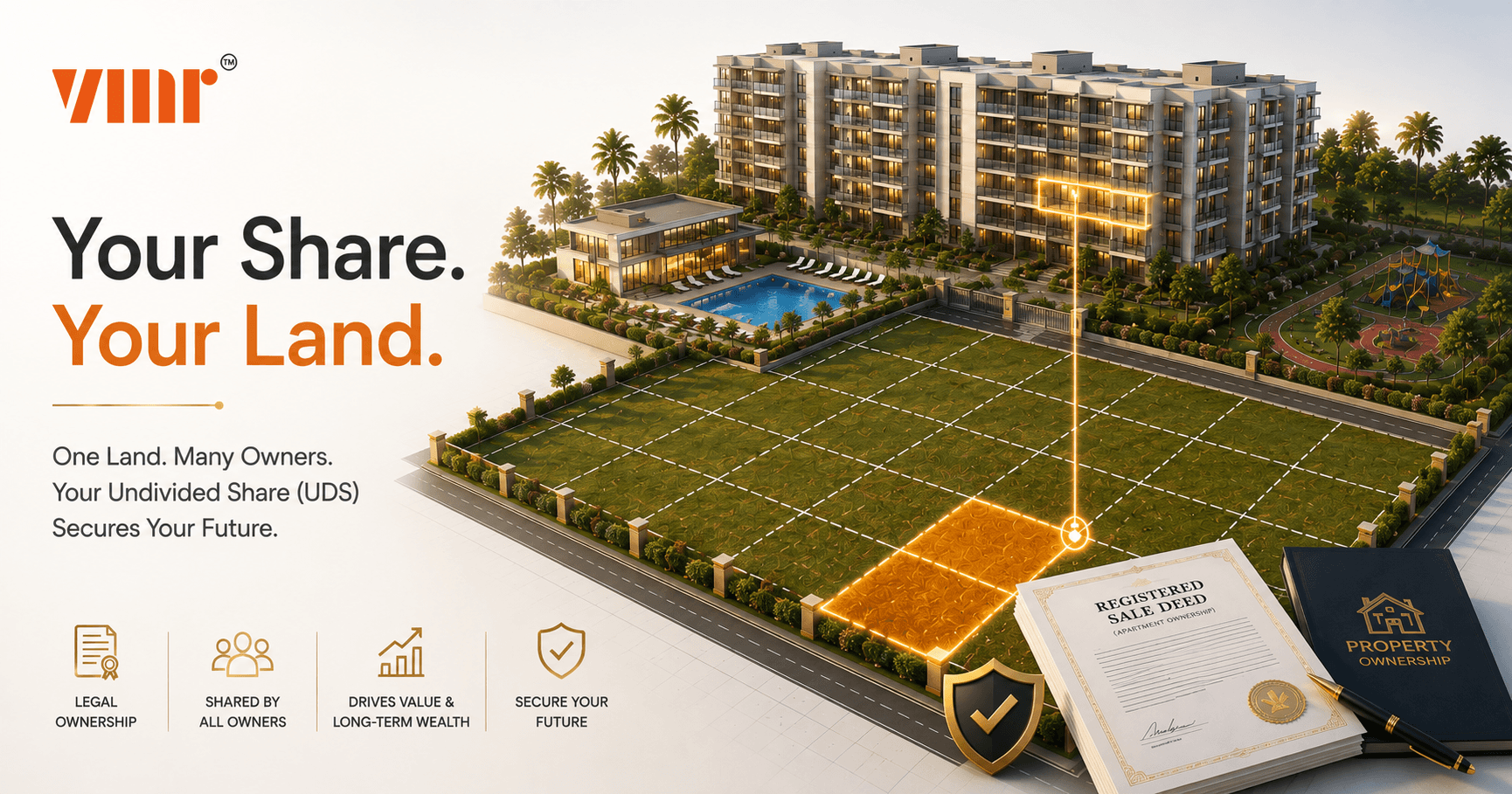
Undivided Share of Land (UDS) — not the clubhouse, the infinity pool, or the jogging track — is what you actually own when you sign your apartment's sale deed. Most buyers walk into a real estate sales office and evaluate amenities first, but none of that is what gets registered in your name. What you own is a fraction of land — your Undivided Share, or UDS — and that number, more than any amenity, determines your property's long-term legal standing and resale value.
This guide explains what UDS is, how it's calculated, why it matters more than the brochure's amenity list, and how to verify your UDS before you commit to a purchase.
Key Takeaways
|
What Is Undivided Share of Land (UDS)?
Undivided Share of Land (UDS) is the proportionate, undivided ownership interest in the total land parcel that a project is built on, allotted to each individual unit owner. When you buy an apartment, you don't own a specific, demarcated patch of the plot beneath the building — you own a fractional, undivided interest in the entire land parcel, shared with every other unit owner in the project.
This distinction matters because UDS is a legal property right recorded in your sale deed and registered with the sub-registrar's office. It is not the same as your apartment's carpet area, built-up area, or super built-up area — those describe the space you occupy inside the building. UDS describes the land you legally own beneath and around it.
Why land ownership works this way in apartments
An independent house sits on its own plot, so the buyer owns that specific, physically demarcated land outright. A multi-storey apartment building cannot be divided that way — dozens or hundreds of units sit on the same physical plot, so the law recognizes an undivided, proportionate share instead of a marked-out portion. Every owner in the project holds simultaneous, overlapping rights over the whole land parcel, in proportion to their UDS — none of them owns a specific corner of it exclusively.
Where UDS is legally documented
UDS becomes a legal right the moment your registered sale deed is executed under the Registration Act and reflected in the property's mutation records with the local municipal authority. Most Indian states, including Telangana, have apartment ownership legislation requiring that a proportionate UDS be conveyed to each buyer as part of the sale, alongside the exclusive right to occupy their specific unit. This is why UDS should never be treated as a marketing detail — it is a statutory component of what you're buying.
How Is UDS Calculated?
UDS is typically calculated using a simple proportional formula based on your unit's share of the project's total built-up area. The standard formula used across most Indian residential developments is:
UDS Formula UDS = (Super Built-up Area of Your Unit ÷ Total Super Built-up Area of All Units in the Project) × Total Land Area of the Project |
Super built-up area — rather than carpet area — is used in this formula because it already accounts for each owner's proportional share of common areas like lobbies, corridors, staircases, and amenity spaces. Since UDS is meant to reflect a similar kind of proportional sharing at the land level, using super built-up area keeps the calculation internally consistent.
Worked example 1: A mid-sized apartment project
Consider a project built on 1 acre (43,560 sq. ft.) of land, with a total super built-up area across all units of 87,120 sq. ft. If your unit's super built-up area is 1,200 sq. ft., your UDS works out to:
(1,200 ÷ 87,120) × 43,560 sq. ft. = approximately 600 sq. ft. of undivided land share
Worked example 2: Comparing two unit sizes in the same project
In the same 1-acre project, a larger 2,400 sq. ft. unit would carry roughly double the UDS of the 1,200 sq. ft. unit above — approximately 1,200 sq. ft. of undivided land share — because UDS scales proportionately with super built-up area within a given project. These figures are illustrative only, to demonstrate the mechanics of the formula. Actual UDS for any specific unit depends on the project's approved layout, total unit count, and land area, and should always be confirmed from the project's sale deed and RERA filing rather than estimated independently.
The role of FSI/FAR in UDS
Floor Space Index (FSI), also called Floor Area Ratio (FAR), is the ratio of a building's total permitted built-up area to the size of the plot it stands on, as fixed by local municipal building regulations. When a project is approved for a higher FSI, developers can legally build more saleable area on the same plot — which means more units are created from the same fixed land parcel, and each unit's UDS shrinks accordingly, even if unit sizes stay similar. The table below illustrates this effect using representative, non-project-specific numbers:
Scenario | Low-FSI Project (fewer units) | High-FSI Project (more units) |
Land area | 1 acre (43,560 sq. ft.) | 1 acre (43,560 sq. ft.) |
Total units built | 30 units | 60 units |
Approx. UDS per 1,200 sq. ft. unit | Higher — land divided among fewer owners | Lower — land divided among more owners |
This is why two apartments of identical size, in two different projects, can carry meaningfully different UDS — the difference comes from how much of the land's development potential the project has utilized, not from the unit itself.
What can reduce your UDS
A higher FSI/FAR utilization, which allows more built-up area on the same land, spreading UDS more thinly across more units
A larger number of units developed on the same land parcel
Land allocated to common areas, amenities, and open spaces, which is factored into the total but doesn't change your proportional share
UDS vs. Carpet Area, Built-up Area, and Super Built-up Area
Buyers often use carpet area, built-up area, super built-up area, and UDS interchangeably, but each measures a different thing and serves a different legal or practical purpose. Understanding the difference prevents a common and costly confusion — assuming a larger apartment automatically means a larger land share.
Term | What It Measures | What It's Used For |
Carpet Area | Usable floor space within your unit's inner walls | Determines actual livable space |
Built-up Area | Carpet area plus wall thickness and balconies | Used for internal space planning and unit layout |
Super Built-up Area | Built-up area plus a proportional share of common areas (lobbies, stairwells, corridors) | Used for pricing and as the basis for the UDS calculation |
Undivided Share of Land (UDS) | Your proportionate ownership interest in the project's total land parcel | Determines legal land ownership — not livable space |
Why UDS Matters More Than the Amenity List
Amenities are usage privileges that can be modified, reduced, or withdrawn by the owners' association over time — UDS is a permanent legal ownership right that cannot be taken away. A clubhouse can be repurposed. A pool can be shut for maintenance and never reopened. But your undivided share of the land is fixed in your sale deed and stays with you for as long as you hold the property.
Legal ownership vs. usage rights
Amenities are shared facilities you have the right to use as a resident — they are not assets you own individually. UDS, on the other hand, is a recorded, transferable, and inheritable ownership interest in real property. If an owners' association is ever restructured, or an amenity space is repurposed or shut down, your right to use that facility can lapse — but your UDS is unaffected, because it is registered with the sub-registrar independently of how the association manages shared facilities.
Resale value
Land is a finite, appreciating asset, while building fixtures and amenities depreciate with age and wear. A higher UDS generally supports stronger long-term resale value because it reflects a larger claim on the appreciating asset — the land — rather than on aging construction and fittings. Two otherwise comparable apartments can diverge meaningfully in long-term value if one carries a noticeably higher UDS than the other, even if the amenity-heavy listing looks more attractive on the surface today.
Redevelopment leverage
When an older building eventually goes in for redevelopment — typically after several decades, once the structure needs major renovation or a developer proposes rebuilding — existing owners generally negotiate as a collective. Compensation offered to them, whether as additional built-up area, a corpus payment, or both, is typically structured in proportion to each owner's UDS, not their unit size or the amenities they enjoyed. Owners with a higher UDS are in a stronger position during these negotiations.
Property tax and loan eligibility
Municipal property tax assessments generally factor in the land component of a property alongside its built-up area, and UDS is the documented basis for that land component in your registered records. Lenders similarly reference your registered ownership share when evaluating a property as loan collateral, since it forms part of what secures the loan. In both cases, it's the figure in your registered documents — not the amenities listed in the project brochure — that gets used.
Inheritance, transfer, and mortgage
UDS transfers cleanly through inheritance, resale, and mortgage because it is part of your registered title, not a separate or negotiable component of your purchase. When a property is inherited, gifted, sold, or mortgaged, the UDS transfers automatically as an inseparable part of the ownership interest. Any future buyer inherits the exact same UDS you hold today — unchanged by anything the developer or the owners' association later decides about amenities.
The Legal and RERA Angle
The Real Estate (Regulation and Development) Act, 2016 (RERA) was enacted to standardize disclosure requirements across Indian real estate transactions, and UDS is one of the project details that registered developers are expected to document as part of their filing. RERA-registered projects disclose UDS details as part of the sale agreement and project documentation, giving buyers a documented basis to verify their share before registration.
Verifying UDS through TS-RERA
For projects in Hyderabad and across Telangana, buyers can cross-check a project's registration status and disclosed layout details, including total land area, through the Telangana Real Estate Regulatory Authority (TS-RERA). Comparing the UDS in your sale agreement against what's filed with TS-RERA is one of the most reliable independent checks available to a buyer, since it doesn't rely solely on documents provided by the seller.
Where to find your UDS as a buyer:
The registered sale deed, where UDS is stated in square feet or as a percentage/fraction of the total land
The project's RERA registration filing, which includes the sanctioned layout and total land area
The allotment letter issued at the time of booking, which should carry the same UDS figure that later appears in the sale deed
A well-documented UDS should be stated unit-wise and specifically — not as a vague aggregate figure for the project as a whole. If a project only discloses a single combined UDS number for all units rather than breaking it down per unit, that is worth asking about directly.
Common Misconceptions About UDS
A few widely held assumptions about UDS don't hold up once you look at how it's actually calculated and legally treated. Clearing these up helps buyers ask sharper questions during due diligence.
"A bigger apartment always means a bigger UDS." Not necessarily — UDS depends on the project's total land area and total unit count, not on your unit size in isolation. A large unit in a very high-FSI project can carry a smaller UDS than a modest unit in a lower-density project on similar land.
"UDS only matters when you sell the property." UDS is relevant from day one, since it underlies your registered ownership, your standing in the owners' association, and how redevelopment or municipal tax matters are eventually calculated — not just at resale.
"All units in a project are guaranteed equal UDS." Only units of comparable size and specification typically carry proportionate, comparable UDS. Different unit types — studio, 2BHK, 3BHK, or penthouse — in the same project usually carry different UDS values, proportionate to their share of the total super built-up area.
Red Flags Buyers Should Watch For
A handful of documentation patterns are worth double-checking before you sign, regardless of which project or developer you're buying from. None of these are unique to any one developer — they're general due-diligence points every buyer should apply.
UDS not mentioned at all, or worded vaguely, in the sale agreement
The same UDS figure quoted for units of noticeably different sizes within the same project
A discrepancy between the UDS stated in the allotment letter and the UDS that later appears in the registered sale deed
Total UDS across all units in a project not adding up to the total land area on record
Land title irregularities or pending litigation on the underlying plot, which can affect the very land your UDS represents a share of, regardless of what the sale agreement states
A project where the developer has retained a portion of land as "additional" or unallocated, outside the UDS pool distributed to buyers, without clear disclosure of what that retained land is for
How to Verify Your UDS Before Buying
Verifying UDS takes a few straightforward document checks, and doing this before booking — not after — gives you the most leverage to ask questions. None of these checks require legal expertise on their own; they simply require requesting and cross-referencing the right documents.
Cross-check the sale agreement against the RERA filing. Confirm the UDS stated in your sale agreement matches the figure in the project's official TS-RERA (or relevant state RERA) registration.
Request the land title and layout approval. Ask for documents showing the project's total plot area and sanctioned layout, so you can independently verify the total land figure used in the UDS calculation.
Compare proportionality across unit types. Confirm that your unit's UDS is proportionate to its carpet or super built-up area relative to other units in the project, using the formula outlined earlier in this guide.
Get an independent legal opinion before registration. For a high-value purchase, having a property lawyer review the sale deed and RERA filing together adds a layer of verification beyond what a buyer can typically confirm alone.
Why UDS Matters More in a High-Growth Corridor Like Medchal-Malkajgiri
In fast-appreciating micro-markets along the Outer Ring Road — including Kompally, Bachupally, Shamirpet, and the broader Medchal-Malkajgiri district — land value is the primary driver of long-term appreciation, which makes UDS especially relevant to buyers in this corridor. As infrastructure development brings more residential and commercial activity to these areas, the land component of a property's value tends to appreciate faster than the building component — making UDS a more meaningful factor here than in slower-growth markets.
Buyers evaluating projects anywhere in this corridor, including VMR Buildcon's upcoming project in Gowdavalli near Kompally, should apply the same UDS verification process outlined above as a standard part of their due diligence, alongside project approvals and RERA registration status. UDS verification isn't a substitute for checking these other fundamentals — it's one more layer of the same due-diligence process, and arguably the layer most buyers skip because amenities dominate the conversation instead.
Leadership Perspective
“At VMR Buildcon, we believe a buyer's trust starts with clarity, not just construction quality. Undivided Share of Land is one of those details that's easy to bury in fine print — we make it a point to spell it out clearly in every sale agreement, because a buyer who understands exactly what they own makes a more confident decision, and that confidence is what builds a lasting relationship with us.”
— Vuddar Madhava Rao, Founder & Managing Director, VMR Buildcon
Quick Facts: UDS at a Glance
Quick Fact | Details |
What it stands for | Undivided Share of Land |
What it represents | Your proportionate ownership interest in a project's total land parcel |
Standard formula | (Unit's super built-up area ÷ Total super built-up area) × Total land area |
Where it's recorded | Registered sale deed, RERA project filing, allotment letter |
What reduces it | Higher FSI/FAR utilization; more units built on the same land |
Governing framework | RERA Act, 2016, and state apartment ownership legislation |
Where to verify (Telangana) | TS-RERA project registration filing |
Why it matters | Legal ownership, resale value, redevelopment compensation, property tax basis |
Conclusion
Amenities are the experience you buy into for as long as you live in a project — UDS is the equity you own regardless of how long you stay. Before you ask about the clubhouse timings or the pool depth, ask for the UDS math. It's the one number in your purchase documents that determines what you actually own, and it's worth understanding before you sign — not after.
Frequently asked questions
There's no single universal benchmark, since UDS depends on a project's total land area, unit count, and FSI utilization. Rather than comparing to a generic percentage, buyers are better served comparing UDS proportionately across units within the same project and confirming it matches the project's overall land area on record.
No. Once your UDS is fixed in the registered sale deed at the time of purchase, it does not change unless there is a formal redevelopment or re-registration process involving all owners in the project. Day-to-day decisions by the owners' association about amenities or shared facilities do not affect your UDS.
UDS should be explicitly stated in the registered sale deed — this is the legally binding document. Brochures may reference UDS generally, but only the figure in the sale deed and RERA filing carries legal weight, so always confirm against those two documents rather than marketing material.
Generally, units of the same size should carry the same UDS within a project, since UDS is calculated proportionately based on super built-up area. If units of similar size show different UDS figures within the same project, that discrepancy is worth raising with the developer directly before registration.
Municipal property tax assessments typically factor in the land component of a property, which is tied to UDS, alongside the built-up area. Buyers should confirm how their local municipal authority calculates tax for their specific unit, since exact methods can vary by jurisdiction.
During redevelopment of an older building, compensation, additional built-up area, or other benefits offered to existing owners are typically negotiated in proportion to each owner's UDS, making it a key factor in redevelopment outcomes and one of the main reasons UDS matters even to buyers who don't plan to sell soon.
UDS as a concept applies specifically to multi-unit developments like apartments, where land is shared among many owners. In a standalone villa or independent house on its own plot, the buyer typically owns the entire underlying land outright rather than an undivided share of it.
Carpet area is the usable floor space within your unit's walls. UDS is your proportionate share of the land the entire project sits on. They are calculated differently and serve different legal purposes — carpet area relates to livable space, UDS relates to land ownership, and a larger carpet area doesn't automatically mean a larger UDS.
UDS should not change after it is documented in the allotment letter and later registered in the sale deed. Any discrepancy between the two documents should be raised with the developer and clarified in writing before registration, since the registered figure is what legally governs your ownership.
RERA-registered projects are required to disclose project documentation, including layout and land details, as part of their registration filing, giving buyers a documented reference point to verify UDS. Buyers should always cross-check the UDS in their sale agreement against the project's official RERA filing — in Telangana, this means the TS-RERA portal.