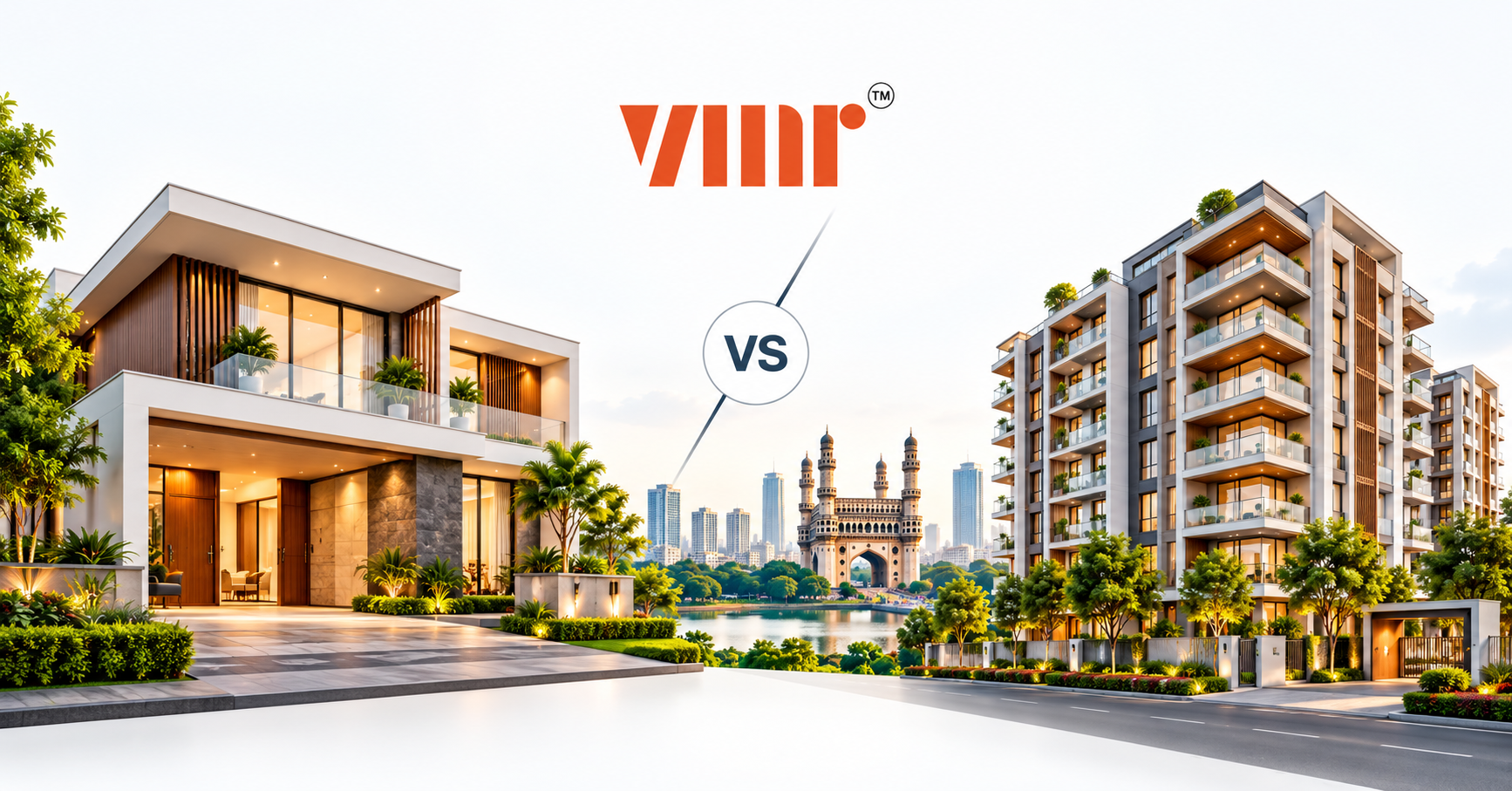
Villa vs. Apartment in Hyderabad: Which Should You Choose?

Written by Vuddar Madhava Rao
Vuddar Madhava Rao is the Founder and Managing Director of VMR Buildcon, a Hyderabad-based real estate developer and turnkey construction company. Since founding VMR Buildcon in January 2000, he has led the delivery of premium residential and commercial projects across Hyderabad, Bangalore, Mumbai, and Vapi — first as a turnkey contractor for established real estate developers, and since 2018 as the developer of VMR Buildcon's own residential community projects.
With over 26 years in construction and real estate, Madhava Rao has built a reputation for engineering precision, on-time delivery, and uncompromising quality standards. Projects delivered under his leadership include Mulberry Meadows, Sai Nest, Sarthak, Fortune Meadows, Westend Meadows, Ipsit Anand Mangal (Borivali West, Mumbai), 21 Square (Borivali West, Mumbai), Satyam II (Malad East, Mumbai), Marquis (Malad West, Mumbai), and Golden Gateway (Borivali East, Mumbai), among others.
VMR Buildcon's current flagship own-development upcoming project is Near Kompally — a 6.75-acre gated community in Gowdavalli, North Hyderabad, that synthesises two and a half decades of construction lessons into a single premium residential development. The project is curated in collaboration with renowned architect Niroop Kumar Reddy.
Beyond VMR Buildcon, Madhava Rao founded Subcontracts.in in 2017 — a civil and infrastructure works contracting and PMC consulting business serving the industrial, warehousing, textiles, IT, tourism, hospitality, and renewable energy sectors across India. He is also the Managing Director of Motoron Automotive Lubricants Pvt Ltd.
Beyond execution, Madhava Rao is an active voice in Hyderabad's real estate market commentary, regularly publishing analysis on Medium and LinkedIn covering North Hyderabad's infrastructure-led growth, the impact of the Kandlakoya IT Park on residential pricing, and the emergence of the Gowdavalli–Kompally corridor as Hyderabad's next premium residential destination.
"Building dreams. Delivering trust. Over two and a half decades at the foundation of Hyderabad real estate."
Education
• Bachelor of Science (BS), Computer Science — Osmania University, Hyderabad (1993–1996)
• Government Model Basic High School, Mahabubnagar, Andhra Pradesh
Languages
English · Hindi · Telugu · Kannada
Areas of Expertise
• Residential real estate development
• Turnkey construction and project management
• Gated community planning and execution
• Hyderabad real estate market analysis
• Construction quality systems and engineering precision
• Civil and infrastructure works contracting (PMC consulting)
• Multi-city project delivery — Hyderabad, Bangalore, Mumbai, Vapi
Other Leadership Roles
• Founder & Principal Consultant, Subcontracts.in (August 2017 – present) — Civil & infrastructure works contracting and PMC consulting
• Managing Director, Motoron Automotive Lubricants Pvt Ltd (June 2017 – present)
Connect
• LinkedIn: https://in.linkedin.com/in/vmadhavarao (32,000+ followers)
• VMR Buildcon: https://vmr.in
• Medium: https://vmrbuildcon.medium.com
• Subcontracts.in: https://www.subcontracts.in
In His Own Words
"Every home we deliver carries the trust of families who place their future in our hands. At VMR, our commitment is to quality, transparency and lasting value."
— Vuddar Madhava Rao
Choose a villa if you want more space, more privacy and full ownership of your own land, and you're ready to manage the upkeep yourself. Choose an apartment if you want lower, predictable maintenance, built-in community security and an easier resale later. In Hyderabad, a low-rise gated apartment often lands in between the two — and for a lot of buyers, that middle path fits best. The rest of this guide walks through exactly why, with the real costs, legal rules and trade-offs behind each choice.
Ramesh spent one Saturday looking at two very different homes. In the morning, he walked through a villa community near Kompally — wide open roads, a private garden in front of every house, kids cycling past without a single car in sight. By afternoon, he was standing in a sample flat on the ninth floor of a high-rise near Kukatpally, looking out over the city, with a gym and a swimming pool two floors below.
By evening, he was more confused than when he'd started.
If that sounds familiar, this guide is for you. We're not going to tell you a villa always wins, or that an apartment always makes more sense — because neither is true. Instead, we'll walk through the real differences that matter: cost, space, upkeep, legal status, financing and what each one is actually worth to you, so you can make the call with your eyes open.
Villa vs Apartment in Hyderabad: What's the Actual Difference?
A villa is a standalone house built on its own plot of land. In Hyderabad today, almost every villa sold by a developer sits inside a gated villa community — shared roads, shared entry security, sometimes a shared clubhouse — but each home stands on its own piece of land, with no walls shared with a neighbour.
An apartment is one unit inside a multi-storey building. The land underneath the whole project is shared. A resident welfare association, or RWA, usually looks after everything outside your front door — the lifts, the lobby, the gardens, the security desk.
That difference in land ownership has a name: UDS, or undivided share of land. Buy a villa, and you typically own 100% of your own plot. Buy an apartment, and you own a proportional slice of the entire project's land — a fair share, but a shared one. Keep that in mind; it matters again later in this guide, when we get to the legal side of things.
Villa, independent house, or plotted development — not always the same thing
The word “villa” gets used loosely in Hyderabad's property market, so it's worth being precise about what you're actually buying.
A genuinely independent house is one where the owner buys land and builds on it alone — no developer, no HOA, no shared systems.
A gated villa community is a project: a developer builds many villas on one large parcel, then hands shared infrastructure over to a resident association — much like an apartment complex does.
A plotted development goes a step further. The developer sells just the plots, with roads and utilities already in place, and buyers build their own homes later, on their own timeline.
Almost every villa marketed in Hyderabad today is the middle option — a gated villa community — not a truly independent house. That distinction matters more than it sounds, especially when we get to RERA a little further down.
Villa vs Apartment in Hyderabad: Quick Comparison Table
Some things are easier to see side by side than to explain in paragraphs. Here's how villas and apartments in Hyderabad compare, factor by factor.
Factor | Villa | Apartment |
Land ownership | 100% of your own plot (UDS) | Proportional share of shared project land |
Typical space | More built-up area and private outdoor space | Compact, efficient footprint |
Privacy | No shared walls or floors | Shared walls, floors and common areas |
Maintenance | Owner handles the structure and garden directly; HOA covers common areas only | RWA bundles common-area upkeep into one monthly charge |
Security | Depends on the community — shared perimeter in a gated project, fully on the owner otherwise | Single entry point, CCTV, staffed desk, higher-density deterrent |
Customization | More freedom, within HOA bylaws | Limited without RWA approval |
RERA coverage | Required if the project crosses 500 sq m of land or 8+ units (Section 3(2)(a)) | Required for virtually all developer-built projects |
Financing | Often a plot/composite loan — lower LTV, shorter tenure | Standard home loan — higher LTV, longer tenure |
Resale liquidity | Smaller buyer pool, typically slower to sell | Broader buyer pool, typically faster to sell |
Best suited for | Long tenure, higher upkeep appetite, land ownership priority | Lower maintenance appetite, flexibility, first-time buyers |
Note: This table compares property types in general, not any specific project's pricing — VMR Buildcon does not currently market a villa product, so no price figures are included here.
Villa vs Apartment — Space, Privacy and Customization
A villa gives you private land — room for a garden, a home office in a separate structure, maybe a small play area for the kids. Within your gated community's bylaws, you can usually extend or reshape the house as your needs change. No shared walls means no shared noise either.
An apartment trades that space for efficiency. The footprint is smaller, walls and floors are shared with neighbours, and any structural change usually needs RWA approval first.
Think about Lakshmi and Karthik, a couple with two school-age kids who've outgrown their 3 BHK flat. They want a home office, a bit of garden for the kids, and room to grow into. Compare that with Ramesh, single and working long hours in the IT corridor, who mostly wants to lock the door and travel without worrying about the property. Same city, same budget range even — but the right answer looks completely different for each of them.
Villa vs Apartment Maintenance — the Cost Most First-Time Buyers Underestimate
This is the part a lot of first-time villa buyers get wrong in their first-year budget.
In a villa, you're directly responsible for the structure, the roof, the exterior walls and the garden. A gated villa community's HOA usually covers common areas — roads, perimeter security, shared landscaping — but nothing that happens inside your own boundary wall. A leaking roof, a cracked driveway, a garden that needs regular upkeep: all of that is on you, and none of it comes as a fixed monthly bill.
In an apartment, an RWA or a professional facility management company bundles lift upkeep, common-area security, landscaping and shared amenities into one predictable monthly charge. You're responsible for the interior — and that's it.
The practical takeaway: apartment maintenance is predictable and budgeted every month. Villa maintenance is variable, seasonal, and easy to underestimate — especially in your first year, before you've learned what your specific home actually needs.
Villa vs Apartment Security — It Depends More on the Community Than the Property Type
Gated apartment complexes usually have a single point of entry, CCTV coverage, and a staffed security desk. Higher occupancy density itself helps too — more eyes, more people around, less opportunity for anything to go unnoticed.
Gated villa communities work similarly at the perimeter — shared entry security, much like an apartment complex — but once you're inside your own boundary wall, your home's security is your responsibility alone.
A genuinely standalone independent house, outside any gated development, carries the most responsibility of all: no shared perimeter, no shared security desk, nothing but what you set up yourself. Most “villa vs apartment” articles blur this by treating every villa as identical — it isn't. Ask specifically whether a villa is part of a gated, managed community before assuming it comes with any shared security at all.
Villa vs Apartment — Legal Status, RERA and Documentation
Here's a misconception worth correcting early: a lot of buyers assume villas sit outside RERA's reach. In most cases, that's simply wrong.
Under Section 3(2)(a) of the Real Estate (Regulation and Development) Act, 2016, a project must register with RERA if the land involved exceeds 500 square metres, or if the number of units to be built exceeds 8 — whichever threshold is crossed first. Most developer-built gated villa communities clear one or both of these thresholds easily, and are therefore required to register with RERA, exactly like an apartment project.
The narrow exception is for a genuinely individual buyer — someone who purchases a single plot and builds their own house on it, entirely outside any marketed, multi-unit project. That's not the situation for the overwhelming majority of villa buyers in Hyderabad, who are buying into a developer-built community.
Practical guidance: always verify a villa project's RERA registration number directly with the Telangana RERA (TS-RERA) authority before booking — the exact same standard you'd apply to an apartment project. Don't assume a villa is exempt just because it's a villa.
There's a second reason the legal side matters here: UDS. As we covered earlier, a villa typically gives you 100% ownership of your own plot, while an apartment gives you a proportional share of shared land. That's not just a feeling of ownership — it's what's actually written on your sale deed, and it affects what you can do with the property long after you've moved in.
Villa vs Apartment Financing — Plot & Construction Loans vs Home Loans
The financing side is where villa and apartment buyers often have very different experiences — and where a lot of first-time villa buyers get an unpleasant surprise.
Loan-to-value: a standard apartment home loan typically funds up to 80–90% of the property's value. A plot loan, or a composite loan for a villa you're building, typically funds a lower 70–75% of the land's market value — and it's usually released in stages, tied to construction milestones, rather than as one lump sum.
Tenure: apartment home loans commonly run up to 30 years. Plot loans are usually capped shorter — often around 15 years for the land portion of the loan.
Now, the part most competitor content skips entirely: how the tax benefit actually works when you're building, not buying ready.
Under Section 22 of the Income Tax Act, 2025, the rule for a home loan used to acquire, construct or repair a property covers exactly this. During construction, you don't get an annual interest deduction at all. Instead, the interest that accrues while you're building — called pre-construction interest — gets added up and claimed later, in five equal instalments, starting from the year construction is completed.
Once that clock starts, the size of your annual deduction depends on timing: if construction finishes within 5 years from the end of the financial year in which you took the loan, your self-occupied home loan interest deduction is capped at ₹2,00,000 a year — the same cap that applies to a ready apartment. Miss that 5-year window, and the cap drops to just ₹30,000 a year, for as long as you hold the loan.
In practice, that means a villa buyer who's building from a plot can wait years before seeing any tax benefit at all — and needs to actually finish construction within five years to get the full deduction later. A ready-apartment buyer, by contrast, starts claiming the deduction from year one, no waiting required.
One clarification, so this doesn't sound scarier than it needs to be: this financing complexity mainly applies to a buy-a-plot-and-self-build purchase. A ready or near-ready home inside a developer-built gated villa community is usually financed much more like a standard home purchase, without the multi-year construction clock.
Villa vs Apartment Property Tax — Does GHMC Really Charge Villas More?
Not directly. But villa owners often do end up paying more — for a different reason than most people assume.
GHMC calculates residential property tax the same way for every home, villa or apartment: Gross Annual Rental Value (plinth area × monthly rental value per square foot × 12) run through a tax-rate slab — roughly 17% to 30%, based on that rental value — minus a 10% depreciation allowance, plus an 8% library cess on top.
The same formula, the same slabs, no separate villa rate.
The real reason villa owners often see a higher tax bill: villas typically have a larger plinth area and a bigger land component than a comparable apartment. That pushes the calculation into a higher slab — a size effect, not a property-type penalty. A large apartment in a premium tower can land in the same higher slab as a modest villa, for the same reason.
Villa vs Apartment — Investment Potential, Appreciation and Rental Yield
Villas offer land-linked appreciation. Over a long enough horizon, in a genuine growth corridor, that can outpace what a comparable apartment does — land itself tends to appreciate, while a building ages. But the buyer pool for villas is smaller, so resale typically takes longer, and the next buyer usually does more due diligence too.
Apartments draw from a much broader buyer pool — working professionals, small families, first-time buyers — which generally means faster resale and steadier rental demand, especially near Hyderabad's employment corridors.
Hyderabad's own geography makes this concrete. The North Hyderabad growth corridor — Kompally, Gowdavalli, Medchal, Kandlakoya, Dundigal, Bachupally, Kukatpally and Miyapur — has more available land, which is exactly where villa communities tend to cluster. Established IT-corridor micro-markets — Tellapur, Kondapur, Gachibowli and the Financial District — are far more land-constrained, which is why high-rise and low-rise apartments dominate there instead.
Rental yield tells a similar story to what we found comparing renting and buying more broadly: yields across Hyderabad typically run in the 3%–6% range, and that gap between yield and loan rates tends to favour end-users who'd live in the home anyway, over investors hoping rent alone covers the EMI — for either a villa or an apartment.
Villa vs Apartment — Lifestyle Fit: Who Should Choose What
Choose a villa if —
You want private outdoor space and don't want to share walls or floors with a neighbour.
You're comfortable managing your own upkeep — or budgeting for someone who will.
You're planning to stay 10 or more years, giving land-linked appreciation time to work.
Full land ownership genuinely matters more to you than convenience.
Choose an apartment if —
You want predictable, bundled maintenance rather than variable upkeep costs.
You value built-in community security without managing it yourself.
You might need to sell or relocate within a few years, and want an easier resale.
You're a first-time buyer working with a moderate budget.
Villa vs Apartment — The Middle Path of Low-Rise Gated Apartments
Here's something worth knowing before you assume it's only a two-way choice: a low-rise gated apartment often sits between a villa and a high-rise flat, not just on the price tag, but on what daily life actually feels like.
A low-rise gated apartment still gives you an apartment's predictable, bundled maintenance — no surprise roof repairs, no seasonal garden bills. But it typically comes with a higher land share per unit than a high-rise tower, and more green, amenity-dense common space, since fewer households are sharing the same plot of land. For a lot of buyers, that's closer to what actually drew them to a villa in the first place — space, quiet, a sense of community — without taking on the upkeep that comes with owning your own patch of land.
It's a genuine gap in how this topic usually gets covered. Every competitor page we reviewed while researching this guide frames villa vs apartment as a strict either-or. None of them mention a middle-density option at all.
If you want to see what that looks like in practice, our guide on low-rise apartments in Hyderabad goes deeper into why density and livability matter more than headline size, and how high-rise and low-rise apartments compare on the specifics.
VMR Buildcon's upcoming project in Gowdavalli near Kompally is built around exactly this idea — low-rise, low-density living with real amenity space, in the same North Hyderabad corridor where villa communities have traditionally clustered.
People don't actually want a villa or a tower — they want space, quiet and a real sense of community. That's what we designed a low-rise home around.
— Madhava Rao, Founder, VMR Buildcon
Villa vs Apartment — A Simple Decision Checklist
Decide your realistic tenure. Under about 5 years usually favours an apartment's liquidity; 10+ years is where a villa's land-linked appreciation has room to work.
Be honest about your upkeep appetite. Do you actually have the time, or the willingness to pay someone, to manage a garden, a roof and exterior repairs?
Check the real financing structure. A plot or construction loan behaves very differently from a standard home loan — don't assume the EMI math is the same.
Verify RERA/TS-RERA registration directly with the authority, whichever property type you're considering. Never assume a villa is exempt.
Weigh the non-financial side. Space and privacy vs convenience and community — against what your household actually needs, day to day, not just on a spreadsheet.
Villa vs Apartment in Hyderabad: Conclusion
There's no universally right answer here. Tenure, upkeep appetite, and how much you value land ownership over convenience decide it — far more than any single cost comparison ever will.
If Ramesh, from the start of this guide, is still deciding: the honest answer is that it depends on which Saturday morning feeling he trusts more — the quiet of the villa, or the convenience of the flat. What this guide can do is make sure whichever he chooses, he's choosing with the full picture, not half of it.
If a villa feels like more space and upkeep than you actually need, but a high-rise flat feels too dense, it's worth touring a low-rise apartment community before you decide — it's a genuine middle option, not just a compromise.
Frequently asked questions
Villas tend to appreciate more over a long horizon because the land itself gains value, but they take longer to resell due to a smaller buyer pool. Apartments resell faster and draw steadier rental demand, especially near job corridors. Neither is universally “better” — it depends on your holding period and how much liquidity you need.
A villa is a standalone house on its own plot, usually inside a gated community, with full ownership of that plot. An apartment is one unit in a multi-storey building, where the land is shared and maintenance is handled collectively through a resident welfare association.
In most cases, yes. Under Section 3(2)(a) of the RERA Act, 2016, any project exceeding 500 square metres of land or 8 units must register with RERA. Most developer-built gated villa communities clear this threshold and are required to register, just like apartment projects — always verify a specific project's status with TS-RERA directly.
It can be, if you're buying a plot and building from scratch. Plot and construction loans typically fund only 70–75% of the land's value over a shorter tenure, versus 80–90% and up to 30 years for a standard apartment home loan. A ready villa in a developer-built community is usually financed more like a normal home purchase.
Apartments have lower, more predictable maintenance because an RWA bundles common-area upkeep into one fixed monthly charge. Villa owners handle their own structure, roof and garden directly, which is often cheaper in a good year but harder to budget for and easy to underestimate.
Not directly — GHMC uses the same rental-value-based formula for both. Villas often land in a higher tax slab simply because they typically have more plinth area and land, not because of any separate villa tax rate.
A gated villa community's shared perimeter security is broadly similar to an apartment complex's. The difference is inside the boundary wall: an apartment's security largely stays with the RWA, while a villa owner is responsible for their own home's security within a shared perimeter.
A villa buyer typically owns 100% of their own plot. An apartment buyer owns a proportional undivided share (UDS) of the entire project's land, based on their unit's size relative to the whole development — a real but shared ownership stake.
Apartments are generally easier and faster to resell, because the buyer pool is larger — working professionals, small families and first-time buyers all shop for apartments. Villas appeal to a narrower buyer base, which typically means a longer time on the market.
Often, yes. A low-rise gated apartment keeps an apartment's predictable, bundled maintenance while offering more land share per unit and more green common space than a high-rise tower — closer to what many villa buyers actually want, without the land-upkeep responsibility.
As a general guide, 10 or more years gives a villa's land-linked appreciation enough time to outweigh its higher upfront cost and slower resale. Under about 5 years, an apartment's faster resale and lower entry cost usually make more financial sense.
Most first-time buyers on a moderate budget are better suited to an apartment: lower entry cost, easier financing with a higher loan-to-value ratio, predictable maintenance, and a faster resale if their plans change. A low-rise apartment can offer more space and community feel within that same budget.
At minimum: the project's RERA registration number (verified directly with TS-RERA), the land title and encumbrance certificate, approved building plan and layout, and the UDS or plot ownership details in the draft sale deed — the same diligence you'd apply to an apartment purchase.