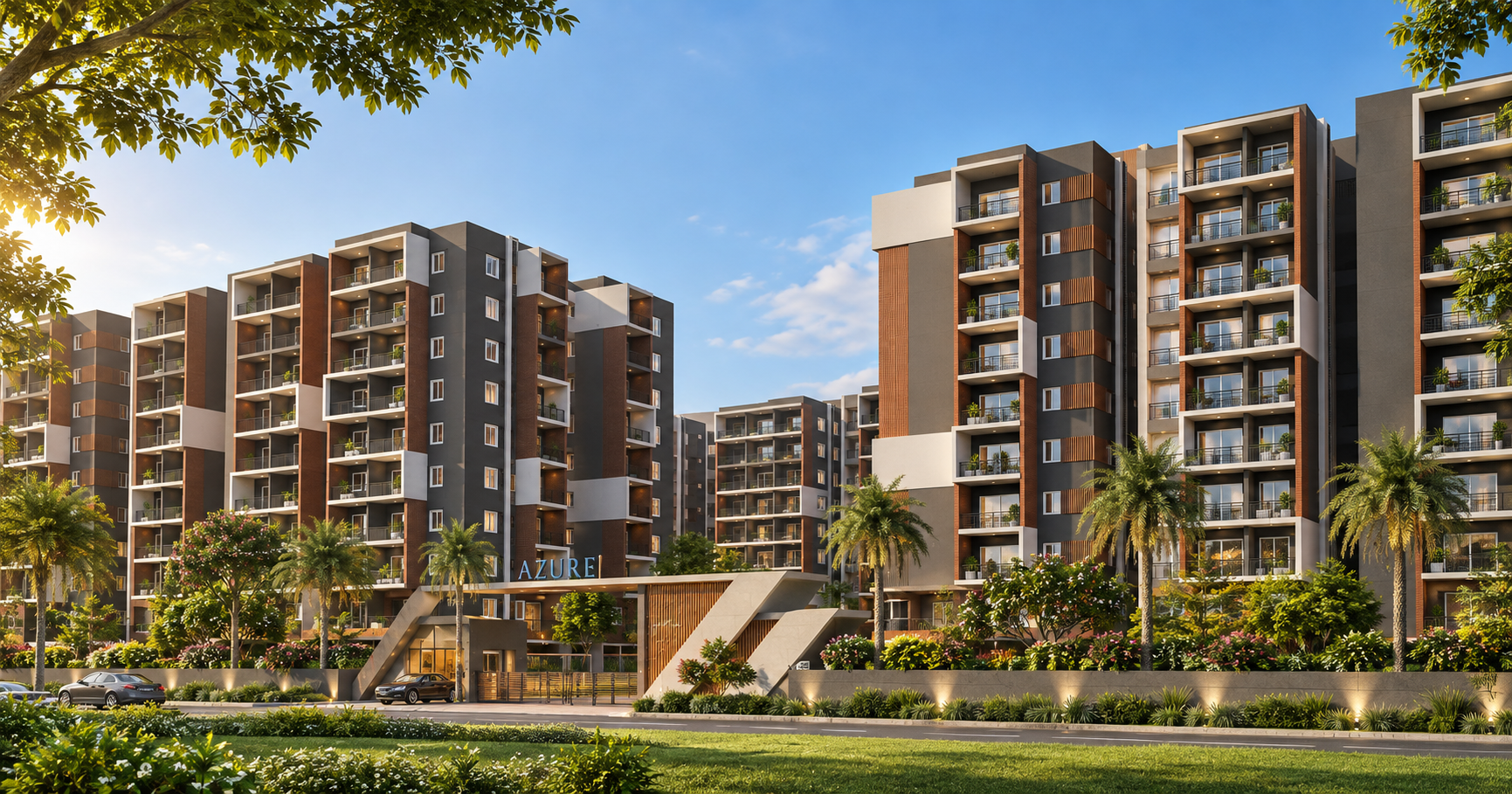
Low-rise apartments have become one of the most specific searches from Hyderabad homebuyers who want more than a brochure full of amenities — they want a home that actually feels like one. A low-rise apartment is typically built up to four or five floors — commonly G+3 or G+4 under Hyderabad's building norms — housing far fewer families per acre than a high-rise tower. For serious buyers comparing options in Hyderabad's fast-growing northern corridor — Kompally, Gowdavalli, and the ORR Exit 5–7 belt — that difference in scale shows up in almost everything: how easily you can book the clubhouse, how much of the land under your building you actually own, and whether you recognise the family in the next unit.
What Is a Low-Rise Apartment?
A low-rise apartment is a residential unit in a building of roughly four to five floors — typically constructed as G+3 or G+4 under Hyderabad's development norms — as opposed to a high-rise tower, which can run to 15, 20, or more floors. The lower floor count directly limits how many households share a given piece of land, which is the foundation of almost everything that makes low-rise living feel different day to day.
Why Serious Buyers Are Choosing Low-Rise Apartments in Hyderabad
Lower Density, Better Amenity Access
Fewer households sharing the same clubhouse, pool, or gym means amenities are typically available on demand rather than requiring advance booking and peak-hour waits. For a full breakdown of how density shapes daily life in a gated community, see our guide on density and livability.
A Larger Undivided Share of Land (UDS)
Since UDS is calculated by dividing a project's total land parcel among all unit owners, a low-rise project with fewer total units on a given plot generally gives each resident a proportionally larger UDS than a comparable high-rise project — a meaningful factor in long-term asset value. Read more in our UDS guide.
Real Community, Not Just Shared Space
A shared space only builds genuine community when residents encounter the same neighbours often enough to recognise them. In a low-rise community, a smaller resident base shares the same courtyard and clubhouse regularly enough for that familiarity to build — something that gets diluted across thousands of households in a high-rise tower.
Less Common-Area Traffic and Congestion
Internal roads, drop-off points, and entry gates carry vehicle and pedestrian load in direct proportion to unit count. Low-rise communities routinely see far less congestion at peak hours than high-density towers with 1,000+ units.
No Elevator Dependency
Low-rise buildings typically involve little to no reliance on elevators for daily movement, which removes one of the most common daily friction points in high-rise living — and matters even more during emergencies, when shorter evacuation paths are a genuine safety advantage.
Low-Rise vs. High-Rise: Quick Comparison
Indicator | Low-Rise Apartments | High-Rise Apartments |
Families per acre | Lower (industry benchmark range) | Higher (industry benchmark range) |
UDS per resident | Proportionally larger on comparable land | Proportionally smaller on comparable land |
Clubhouse & amenity access | On-demand, minimal waiting | Booking required, peak-hour waits common |
Common-area traffic | Light | Heavy, especially at gates and drop-off zones |
Elevator dependency | Minimal to none | High — waits during peak hours |
Noise and privacy | Greater separation between homes | More shared walls, higher ambient noise |
Community familiarity | Same faces, same spaces, regularly | Anonymous, low repeat contact |
Where Hyderabad's Low-Rise Communities Are Emerging
Hyderabad's northern growth corridor — spanning Kompally, Gowdavalli, and the broader Medchal-Malkajgiri belt along ORR Exits 5 through 7 — has become one of the city's most active zones for new low-rise gated community development. Lower land costs relative to core Hyderabad, combined with improving connectivity, have made this corridor attractive to developers building at lower density — where more land per project translates directly into more space per resident.
VMR Buildcon's Upcoming Low-Rise Project Near Kompally
VMR Buildcon is developing a new low-rise gated community in Gowdavalli, near Kompally — designed around the same principles this page has covered: fewer families per acre, more usable open space, and a genuine sense of community rather than a crowded amenity list. The project is currently in its pre-launch phase, with RERA registration in progress. The community has been curated in collaboration with architect Niroop Kumar Reddy, reflecting a philosophy refined across more than two decades of construction and development work: that a home should give a family room to live in, not just a checklist of shared facilities.
At VMR Buildcon, low-rise isn't a compromise — it's the whole point. When we build at a lower density, every family gets more land, more privacy, and a real chance to know their neighbours.”
— Vuddar Madhava Rao, Founder & Managing Director, VMR Buildcon.
Frequently asked questions
A low-rise apartment is a residential unit in a building of roughly four to five floors — typically G+3 or G+4 under Hyderabad's building norms — as opposed to a high-rise tower, which can run to 15 floors or more.
The main difference is density: low-rise buildings house far fewer families per acre than high-rise towers, which directly affects clubhouse access, common-area traffic, UDS per resident, and day-to-day privacy.
Yes. VMR Buildcon is developing a low-rise gated community in Gowdavalli, near Kompally, currently in its pre-launch phase with RERA registration in progress.
Lower density typically means shorter waits for shared amenities, less common-area traffic, more usable open space, better acoustic privacy, and — since the same land is divided among fewer units — a proportionally larger undivided share of land (UDS) per resident.
Generally, yes. Since UDS is calculated by dividing a project's total land parcel among all unit owners, a low-rise project with fewer total units on a given plot typically gives each resident a proportionally larger UDS than a comparable high-rise project.
Many families find low-rise living easier for young children and elderly residents, since there's less dependency on elevators, shorter evacuation paths, and typically quieter, less congested common areas.
The project is currently in its pre-launch phase, with RERA registration in progress.
Low-rise apartments in Hyderabad are commonly built as G+3 or G+4 structures, though exact permissible floor counts depend on plot size, road width, and local development regulations.
Lower-density projects are increasingly appealing to buyers who prioritise livability and land value over sheer amenity count, which can support long-term desirability — though investment outcomes always depend on location, developer track record, and market conditions.
You can explore project updates, floor plans, and site visit scheduling on VMR Buildcon's dedicated project page for its upcoming Kompally-area development.