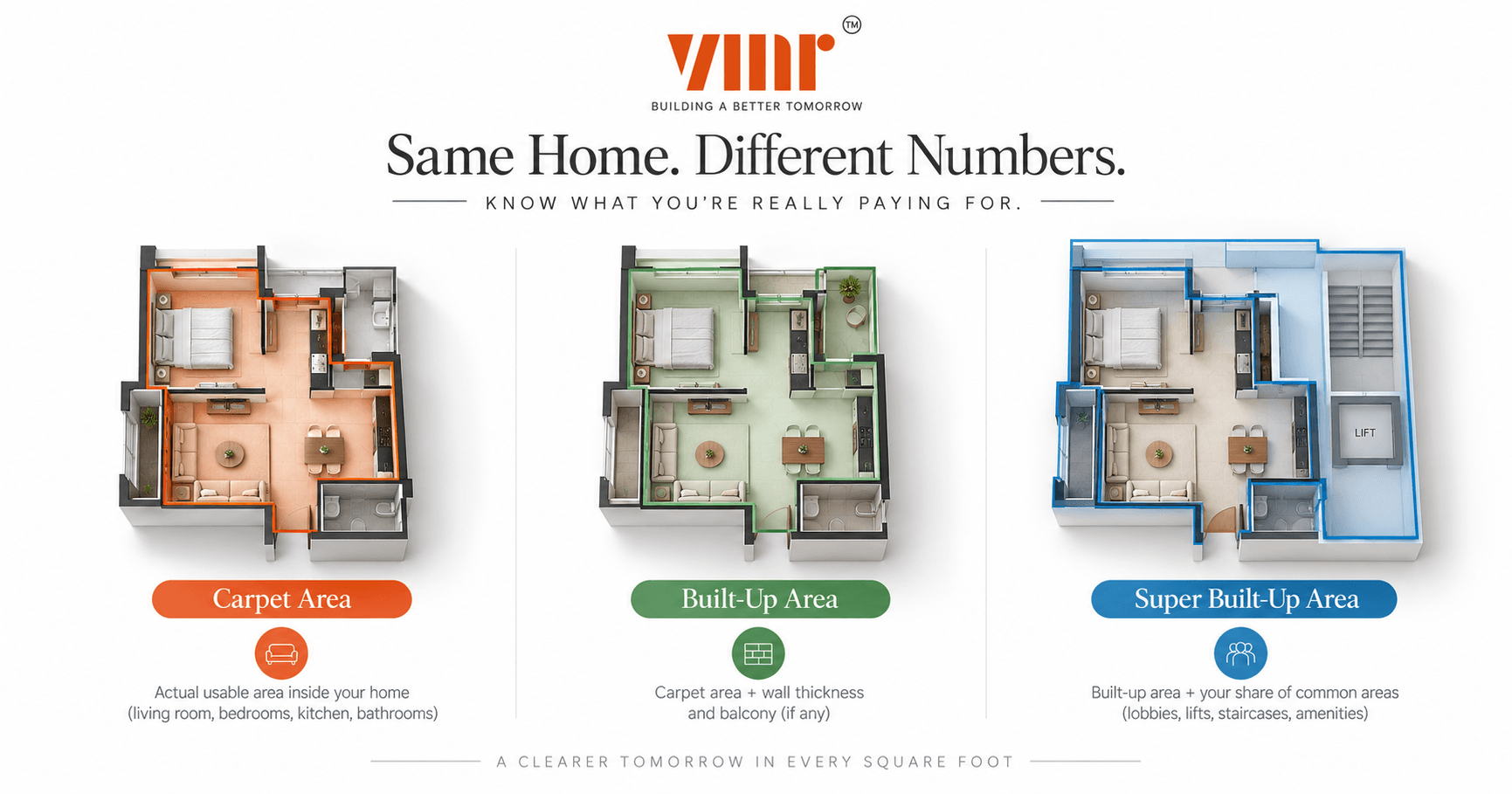
Carpet Area vs. Built-Up Area vs. Super Built-Up Area: What You're Really Paying For

Written by Vuddar Madhava Rao
Vuddar Madhava Rao is the Founder and Managing Director of VMR Buildcon, a Hyderabad-based real estate developer and turnkey construction company. Since founding VMR Buildcon in January 2000, he has led the delivery of premium residential and commercial projects across Hyderabad, Bangalore, Mumbai, and Vapi — first as a turnkey contractor for established real estate developers, and since 2018 as the developer of VMR Buildcon's own residential community projects.
With over 26 years in construction and real estate, Madhava Rao has built a reputation for engineering precision, on-time delivery, and uncompromising quality standards. Projects delivered under his leadership include Mulberry Meadows, Sai Nest, Sarthak, Fortune Meadows, Westend Meadows, Ipsit Anand Mangal (Borivali West, Mumbai), 21 Square (Borivali West, Mumbai), Satyam II (Malad East, Mumbai), Marquis (Malad West, Mumbai), and Golden Gateway (Borivali East, Mumbai), among others.
VMR Buildcon's current flagship own-development upcoming project is Near Kompally — a 6.75-acre gated community in Gowdavalli, North Hyderabad, that synthesises two and a half decades of construction lessons into a single premium residential development. The project is curated in collaboration with renowned architect Niroop Kumar Reddy.
Beyond VMR Buildcon, Madhava Rao founded Subcontracts.in in 2017 — a civil and infrastructure works contracting and PMC consulting business serving the industrial, warehousing, textiles, IT, tourism, hospitality, and renewable energy sectors across India. He is also the Managing Director of Motoron Automotive Lubricants Pvt Ltd.
Beyond execution, Madhava Rao is an active voice in Hyderabad's real estate market commentary, regularly publishing analysis on Medium and LinkedIn covering North Hyderabad's infrastructure-led growth, the impact of the Kandlakoya IT Park on residential pricing, and the emergence of the Gowdavalli–Kompally corridor as Hyderabad's next premium residential destination.
"Building dreams. Delivering trust. Over two and a half decades at the foundation of Hyderabad real estate."
Education
• Bachelor of Science (BS), Computer Science — Osmania University, Hyderabad (1993–1996)
• Government Model Basic High School, Mahabubnagar, Andhra Pradesh
Languages
English · Hindi · Telugu · Kannada
Areas of Expertise
• Residential real estate development
• Turnkey construction and project management
• Gated community planning and execution
• Hyderabad real estate market analysis
• Construction quality systems and engineering precision
• Civil and infrastructure works contracting (PMC consulting)
• Multi-city project delivery — Hyderabad, Bangalore, Mumbai, Vapi
Other Leadership Roles
• Founder & Principal Consultant, Subcontracts.in (August 2017 – present) — Civil & infrastructure works contracting and PMC consulting
• Managing Director, Motoron Automotive Lubricants Pvt Ltd (June 2017 – present)
Connect
• LinkedIn: https://in.linkedin.com/in/vmadhavarao (32,000+ followers)
• VMR Buildcon: https://vmr.in
• Medium: https://vmrbuildcon.medium.com
• Subcontracts.in: https://www.subcontracts.in
In His Own Words
"Every home we deliver carries the trust of families who place their future in our hands. At VMR, our commitment is to quality, transparency and lasting value."
— Vuddar Madhava Rao
Term | What It Includes | Legal Status |
Carpet Area | Net usable floor area within the walls, including internal partition walls | Legally mandated disclosure under RERA |
Built-Up Area | Carpet area + wall thickness + balcony/utility areas | Not RERA-mandated for sale quoting |
Super Built-Up Area | Built-up area + proportionate share of common areas (lobbies, stairs, corridors) | Not RERA-mandated; historically used for pricing |
The single most common shock for first-time apartment buyers in Hyderabad is discovering that the “1,500 sq ft” unit they're paying for has nowhere near 1,500 sq ft of space they can actually use. That gap exists because Indian real estate historically quoted — and often still markets — apartments using three different area measurements: carpet area, built-up area, and super built-up area. Each one is a legitimate, defined term, but they measure very different things, and the difference between the largest and smallest figure can run to 25–35% of the quoted size. Knowing exactly what you're paying for, per square foot, starts with understanding these three terms precisely.
What Is Carpet Area?
Carpet area is the net usable floor area of an apartment — literally, the area you could cover with a carpet — excluding external walls, but including the internal partition walls within the unit. It excludes exclusive balconies, verandahs, and open terraces. This is the figure that matters most in practice, because it represents the actual livable space inside your four walls — and it's the metric the RERA Act, 2016 made legally mandatory for real estate sale agreements across India, specifically to stop the inflated-area marketing that was common before the law came into effect.
What Is Built-Up Area?
Built-up area is carpet area plus the thickness of the walls and the area of balconies or utility spaces attached to the unit. Built-up area gives a slightly more complete picture than carpet area alone, since it accounts for the physical footprint of the unit rather than just the usable interior — but it still doesn't include any share of the building's common areas.
What Is Super Built-Up Area?
Super built-up area is built-up area plus a proportionate share of the building's common areas — lobbies, staircases, corridors, and sometimes amenity spaces like the clubhouse. This is historically the figure developers used when advertising and pricing a unit, since it's the largest of the three numbers — which is exactly why RERA stepped in to require carpet-area-based disclosure instead.
Why RERA Made Carpet Area the Legal Standard
Before RERA, a buyer could be quoted a price based on super built-up area without ever being told how much of that figure was actually usable space inside their unit. The RERA Act, 2016 changed this by legally requiring that the price per square foot in any sale agreement be based on carpet area, not super built-up or built-up area. This doesn't stop developers from mentioning super built-up area in marketing material — but the binding legal agreement must state carpet area, giving buyers a consistent, comparable number across different projects and developers.
How to Calculate the Loading Factor
The loading factor is the percentage difference between super built-up area and carpet area, and it's the single most useful number for comparing efficiency across projects. It's calculated as: (Super Built-Up Area − Carpet Area) ÷ Carpet Area × 100. A lower loading factor means a larger share of what you're paying for is actual usable carpet area inside your unit — a higher loading factor means more of your payment is going toward shared common areas rather than your own living space.
A loading factor around 20–25% is commonly considered efficient.
A loading factor above 35–40% means a significant share of the quoted area is common space, not usable interior.
Always ask for the exact carpet area figure in square feet, not just the loading factor percentage, since the same percentage can represent very different actual space depending on the base carpet area.
Carpet Area vs. Built-Up Area vs. Super Built-Up Area: Side-by-Side
Aspect | Carpet Area | Built-Up Area | Super Built-Up Area |
Includes internal walls | Yes | Yes | Yes |
Includes external wall thickness | No | Yes | Yes |
Includes balcony/utility area | No (excluded) | Yes | Yes |
Includes share of lobbies, stairs, corridors | No | No | Yes |
Used for RERA-mandated sale agreements | Yes | No | No |
Typically largest of the three figures | No — smallest | Middle | Yes — largest |
Why This Matters More in Low-Rise vs. High-Rise Projects
Loading factors tend to run higher in high-rise towers than in low-rise buildings, simply because tall towers need more shared infrastructure per unit — multiple elevators, larger lobbies, longer corridors, bigger fire-safety staircases. A low-rise building, with fewer floors and simpler common-area design, often converts a larger share of its super built-up area into actual carpet area for residents - which connects directly to the same efficiency argument made in our density and UDS guides: less shared infrastructure per unit generally means more of what you're paying for is genuinely yours to use.
How to Verify These Figures Before You Buy
Ask for the RERA-registered carpet area figure directly — this is a legal disclosure requirement, not optional information.
Cross-check the carpet area stated in marketing material against the figure in the actual sale agreement; they must match.
Calculate the loading factor yourself using the formula above, rather than relying on a developer's stated percentage.
Compare loading factors across a few projects in the same corridor before assuming any one figure is “normal.”
Ask specifically whether balconies and utility areas are included in the quoted carpet area — they should not be, under the RERA definition.
VMR Buildcon's Approach
VMR Buildcon's upcoming low-rise project in Hyderabad's Gowdavalli, near Kompally, is being designed with exactly this efficiency question in mind — fewer shared common areas per unit, by virtue of building at a lower density, generally means a better carpet-area-to-super-built-up-area ratio for residents. Full carpet area and pricing details will be published once RERA registration is complete.
“We've always believed a buyer should know exactly how much of what they're paying for they can actually stand inside. That's not a regulatory checkbox for us — it's the whole point of building efficiently.” — Vuddar Madhava Rao, Founder & Managing Director, VMR Buildcon.
Conclusion
Carpet area, built-up area, and super built-up area all describe the same apartment — but they answer very different questions. Carpet area tells you how much space you can actually use, and it's the number the law requires developers to quote in your sale agreement. Built-up area and super built-up area add the building's physical footprint and shared infrastructure on top, which is useful context but shouldn't be mistaken for livable space. Before signing anything, calculate the loading factor yourself, ask for the RERA-registered carpet area figure in writing, and compare it across a few projects - it's one of the fastest ways to see which developer is actually giving you more for your money. For a related look at how density affects what you get for your money, see our guides on undivided share of land and density and livability in gated communities.
Frequently asked questions
Carpet area is the net usable floor area of an apartment, excluding external walls, balconies, and terraces, but including internal partition walls. It's the legally mandated figure under RERA for real estate sale agreements in India.
Built-up area adds the thickness of the walls and any balcony or utility space to the carpet area. Carpet area is always the smaller of the two figures, since it only counts usable interior space.
Super built-up area is built-up area plus a proportionate share of the building's common areas, such as lobbies, staircases, and corridors. Developers historically used it for pricing because it's the largest of the three figures, which is why RERA now requires carpet-area-based disclosure in sale agreements instead.
Carpet area is the figure RERA requires to be stated in the sale agreement and used for calculating the price per square foot. Super built-up area may still appear in marketing material, but it isn't the legally binding figure.
Loading factor is calculated as (Super Built-Up Area − Carpet Area) ÷ Carpet Area × 100, expressed as a percentage. A lower percentage means more of the quoted area is actual usable carpet area.
A loading factor in the range of roughly 20–25% is commonly considered efficient, while anything above 35–40% means a significant share of the quoted area is shared common space rather than usable interior. Always verify current benchmarks, since this varies by project and building type.
Before RERA, buyers were often quoted prices based on super built-up area without a clear picture of how much space was actually usable. The RERA Act, 2016 made carpet area the mandatory basis for sale agreements to give buyers a consistent, comparable figure across developers.
No. Under the RERA definition, carpet area excludes exclusive balconies, verandahs, and open terrace areas, even though these may be included in built-up or super built-up area figures.
Low-rise buildings generally require less shared infrastructure per unit — fewer elevators, smaller lobbies, shorter corridors — which can result in a lower loading factor compared to high-rise towers. This varies by specific project design and is worth verifying with real project data before buying.
Ask for the RERA-registered carpet area figure directly, and confirm that the same number appears in both the marketing material and the actual sale agreement. Calculating the loading factor yourself is the fastest way to sanity-check a developer's claims.